
IPO basics · Explainer
IPO investor categories explained: who the QIB, anchor, sNII, bNII, retail, employee and shareholder categories are, how much of an issue each gets, how each is allotted and which one a bid of a given size falls into, with a worked allotment example.
Quick answer
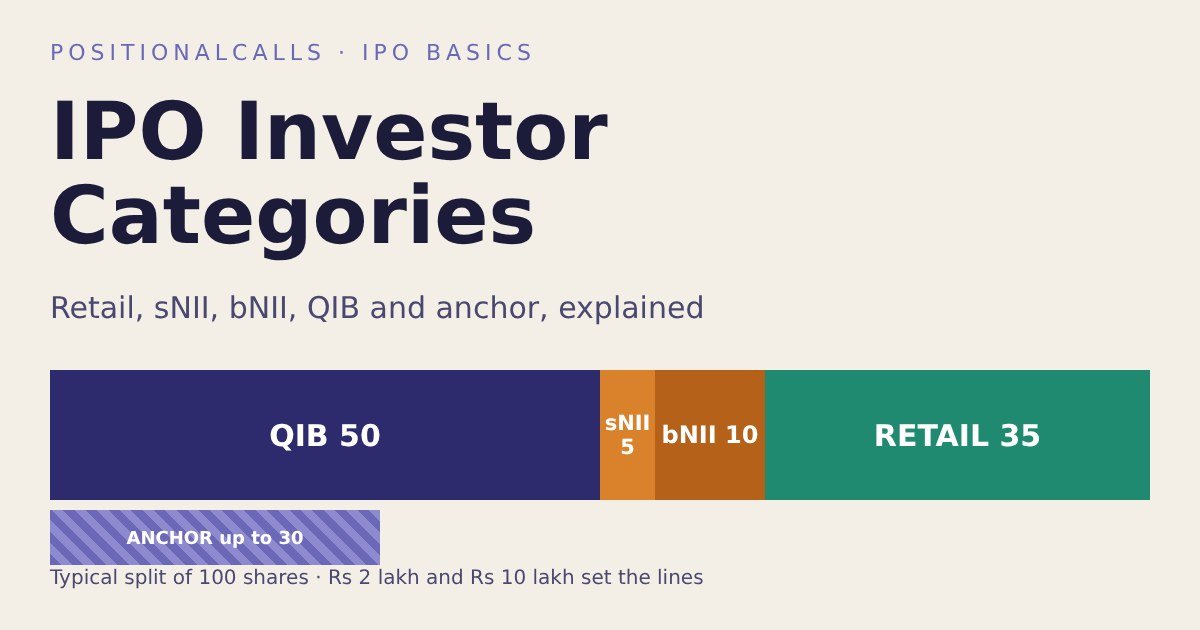
IPO investor categories are QIB, non-institutional (sNII and bNII) and retail, plus employee and shareholder quotas. A typical profitable issue reserves up to 50% for QIBs, 15% for NIIs and 35% for retail. Retail bids up to Rs 2 lakh, sNII Rs 2 to 10 lakh, and bNII above Rs 10 lakh.
Latest update (Monday, 16 November 2026, 12:00 PM IST): first version of this guide. The category shares, anchor rules and allotment methods come from Chittorgarh and IPO Market. The sNII and bNII split date comes from TradingQnA. I did not open the SEBI ICDR text, so each issue’s prospectus is the final word. The hypothetical issue in the worked example is my own illustration, not a real IPO.
Key takeaways
- Category is set by bid size: up to Rs 2 lakh is retail, above that is NII.
- Retail is a lottery: when oversubscribed, a winner gets one lot.
- QIB is pro rata: institutions get a fixed share of their bid, not a lot.
- Anchors come first: they are allotted a day before the issue opens.
In plain words: when a company sells shares to the public, it reserves slices of the issue for different kinds of buyers. Each slice has its own size and its own way of dividing shares when there are too many bids. You do not choose your slice; the size of your bid does. Nothing here tells you to apply for or skip any IPO.
Data note: as of Monday, 16 November 2026, 12:00 PM IST. Percentages are the typical mainboard split for a profit-eligible issuer. The Crystal Crop figures are from the reported band (Rs 259 to Rs 272) and lot (55 shares), and the allotment example uses a hypothetical issue of 1 crore shares with a 55-share lot.
What are IPO investor categories?
IPO investor categories are the groups into which a public issue is divided: qualified institutional buyers (QIB), non-institutional investors (NII, split into small and big), retail individual investors, and sometimes employees and shareholders. Each group has a reserved share of the issue and its own allotment method.
An issue is not one pool in which every bid is treated alike. The company and its lead managers reserve a slice for each type of buyer, and the exchange systems count bids against that slice. A retail bid competes only with other retail bids. A QIB bid competes only with other QIB bids. That is why one IPO can show a retail subscription of 3 times and a QIB subscription of 60 times at the same moment.
The IPO investor categories also explain several things readers ask about: why a bid of Rs 2.09 lakh behaves differently from Rs 1.94 lakh, why retail investors are picked by lottery, and why institutions get a fraction of their bid. Each section below states the rule, the source and the example. For the mechanics of placing a bid, see how to apply for an IPO in India.
This is educational. PositionalCalls is not SEBI-registered, and nothing here is advice to apply for or avoid an issue.
How an issue is split across IPO investor categories
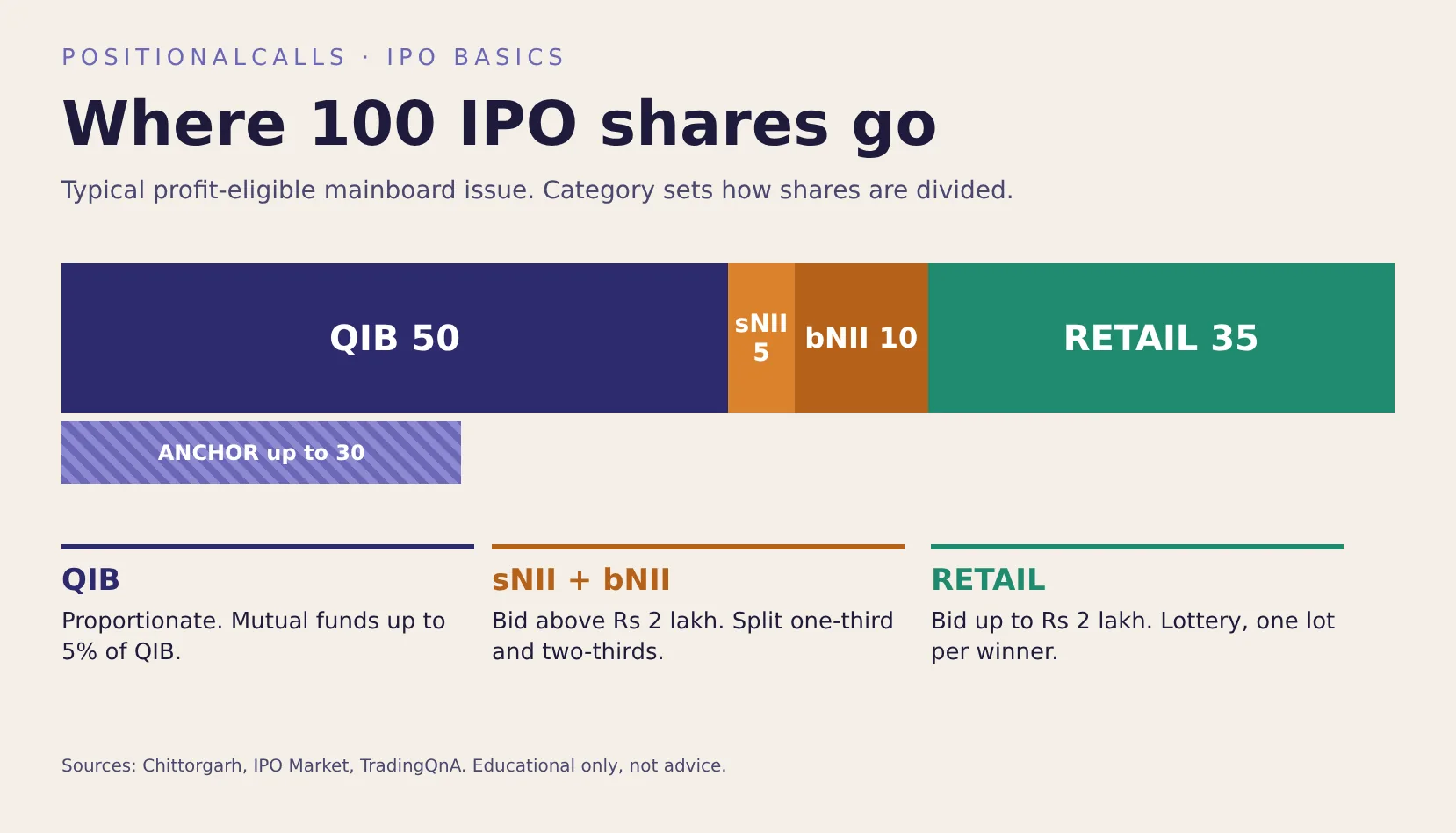
A typical profit-eligible mainboard issue reserves up to 50% for QIBs, at least 15% for non-institutional investors and at least 35% for retail. If the issuer misses the profit test, QIBs take at least 75% and retail is capped at 10%.
| Category | Typical share of issue | Who bids | Allotment above 1x subscription |
|---|---|---|---|
| QIB | Up to 50% | Mutual funds, insurers, banks, foreign institutions | Proportionate |
| of which anchors | Up to 60% of the QIB portion, so up to 30% of the issue | Large institutions, allotted before opening | Discretionary, set by issuer and lead manager |
| NII (sNII plus bNII) | At least 15% | Bids above Rs 2 lakh | sNII one-third, bNII two-thirds; see section below |
| Retail | At least 35% | Bids up to Rs 2 lakh | Computerised lottery |
| Employee | 0% to 5%, optional | Employees of the issuer | Proportionate |
Cite this table: PositionalCalls, “IPO Investor Categories: Typical Split, as of 16 November 2026”; IPO Market and Chittorgarh.
When the issuer does not meet the profit test
IPO Market and TradingQnA say that an issuer that has not been profitable over the required period uses the route in which at least 75% goes to QIBs and retail is capped at 10%. TradingQnA states the NII share stays at 15%. IPO Market gives no NII figure for that case, so I rely on the prospectus’s own reservation table for any specific issue. The same alternative route appears in the mainboard rules summarised in our SME vs mainboard IPO guide.
These shares are caps and floors, not promises about demand. An issue can be undersubscribed in one category and heavily oversubscribed in another. Chittorgarh notes that unsubscribed QIB shares cannot be moved to other categories, so a huge QIB subscription does not create extra shares for retail.
The retail category in IPO investor categories
The retail category is for bids up to Rs 2 lakh. When retail demand exceeds the shares reserved, allotment is a computerised lottery and a winner gets one lot. The number of winners is the retail shares offered divided by the lot size.
Chittorgarh sets out the mechanics. Each retail investor gets at least one lot if enough shares are reserved. The maximum number of allottees equals the retail shares offered divided by the lot size. Its example is 842,865 retail shares and a 22-share lot, giving 38,312 allottees. If applications exceed that number, a lottery decides, with at most one lot per winner. If they fall short, everyone gets one lot and the remainder is allotted pro rata.
| Retail situation | What happens | Source |
|---|---|---|
| Applications below maximum allottees | Everyone gets one lot; remaining shares go pro rata | Chittorgarh |
| Applications above maximum allottees | Computerised lottery; one lot per winner | Chittorgarh; IPO Market |
| Undersubscribed (below 1x) | Every valid bid is allotted in full; the issue needs at least 90% subscription | Chittorgarh |
| Bid above Rs 2 lakh | Not retail; the bid moves to sNII or bNII | Chittorgarh; IPO Market |
Cite this table: PositionalCalls, “Retail Category Allotment Rules, as of 16 November 2026”; Chittorgarh, IPO Market.
Because the lottery gives each valid application zero or one lot, the sources imply that bidding for several lots does not raise the chance of being picked when the category is oversubscribed. It only blocks more money in your account. When the category is undersubscribed, that logic does not apply, since every valid bid is allotted in full. This describes how the rules work and is not advice.
sNII and bNII: the non-institutional IPO investor categories
The non-institutional category is split by bid size. A small NII (sNII) bids above Rs 2 lakh and up to Rs 10 lakh, and a big NII (bNII) bids above Rs 10 lakh. The sNII quota is one-third of the NII portion, or 5% of the issue, and bNII gets two-thirds, or 10%.
| Sub-category | Bid size | Share of NII portion | Share of a 15% NII issue |
|---|---|---|---|
| sNII | Above Rs 2 lakh, up to Rs 10 lakh | One-third | 5% of the issue |
| bNII | Above Rs 10 lakh | Two-thirds | 10% of the issue |
Cite this table: PositionalCalls, “sNII and bNII Quotas, as of 16 November 2026”; Chittorgarh, IPO Market, TradingQnA.
TradingQnA says the split took effect on 1 April 2022 under an amendment to SEBI’s ICDR Regulations and cites no circular number. Retail and QIB reservations did not change. I did not open the SEBI notice, so treat the date as a secondary report.
How shares are divided inside NII
The sources differ, and the prospectus governs. Chittorgarh says each NII investor gets the minimum bid lot if shares allow and the remaining shares go pro rata. It adds that in an oversubscribed issue, bNII is allotted the minimum NII bid amount, Rs 2 lakh worth, the same as sNII. TradingQnA says sNII is allotted by draw of lots like retail, while bNII stays pro rata, and a commenter there disputed the bNII example. The practical point on which they agree is that a bigger bid does not guarantee a bigger allotment.
A bid just above Rs 2 lakh therefore changes your category and your allotment method, not only your amount. At Crystal Crop’s Rs 272 top price and 55-share lot, 13 lots cost Rs 1,94,480 and stay retail, while 14 lots cost Rs 2,09,440 and become sNII (my calculation).
QIB and mutual funds in the IPO investor categories
Qualified institutional buyers are allotted proportionately when their category is oversubscribed. Chittorgarh says mutual funds get up to 5% of the QIB category, and the rest goes pro rata to other QIBs.
Proportionate allotment means every QIB bidder gets the same fraction of its bid. IPO Market’s example is a QIB category subscribed 4 times: each applicant gets 25% of its bid. On my own number, a QIB that bid for 1,000 shares at 4 times subscription would receive 250 shares (my calculation). Undersubscribed, all QIBs get full allotment, but unsubscribed QIB shares cannot be moved to other categories.
| QIB feature | Rule | Source |
|---|---|---|
| Allotment | Proportionate when oversubscribed | Chittorgarh; IPO Market |
| Mutual fund share | Up to 5% of the QIB category; the rest pro rata to other QIBs | Chittorgarh |
| Unsubscribed QIB shares | Cannot be moved to other categories | Chittorgarh |
| Typical reservation | Up to 50%; at least 75% if the profit test is missed | IPO Market; TradingQnA |
Cite this table: PositionalCalls, “QIB Category Rules, as of 16 November 2026”; Chittorgarh, IPO Market, TradingQnA.
Anchor investors: the part of QIB allotted before the issue opens
Anchor investors are a sub-group of the QIB category. They can take up to 60% of the QIB portion, which is up to 30% of a typical issue, and are allotted shares a day before the public issue opens. One-third of the anchor portion is reserved for domestic mutual funds.
Chittorgarh says the issuer and its lead manager choose the anchors and the allocation. IPO Market adds that allocation happens one day before public subscription opens, and that anchors are not a separate category. If the final offer price is higher than the anchor price, anchors receive a revised confirmation for the differential payment, and the price for anchors cannot be lower than for other applicants.
| Issue size | Number of anchors | Minimum per anchor |
|---|---|---|
| Up to Rs 10 crore | Maximum 2 | Not stated in the source |
| Rs 10 crore to Rs 250 crore | Minimum 2, maximum 15 | Rs 5 crore |
| Above Rs 250 crore | Minimum 5; maximum 15 for the first Rs 250 crore plus 10 more for each additional Rs 250 crore | Rs 5 crore |
Cite this table: PositionalCalls, “Anchor Investor Allocation Limits, as of 16 November 2026”; Chittorgarh.
Anchor shares are locked in for a period after allotment. Alice Blue, a secondary summary, puts the lock-in at 50% for 30 days and 50% for 90 days. The lock-in dates are in the prospectus. Anchor demand shows institutions’ interest before the retail window, but it says nothing about how the shares will trade.
PositionalCalls WhatsApp channel
Get IPO explainers on WhatsApp
- Category and allotment rules, dated
- Plain-English IPO terms, no tips
- Links to updated IPO guides
Employee and shareholder quotas
Some issues reserve shares for the issuer’s employees or for existing shareholders of a listed parent. Both are allotted proportionately if oversubscribed, with limits that Chittorgarh describes.
- Employees: pro rata on oversubscription. The maximum allocation is Rs 2 lakh, unless the employee portion is undersubscribed, in which case the unsubscribed part goes pro rata to eligible employees for values up to Rs 5 lakh.
- Shareholders: proportionate allocation on oversubscription.
- One category per PAN: Chittorgarh says that bidding over Rs 2 lakh in the shareholder category and in any other category is treated as multiple bids and rejected.
These quotas are optional and small. Read the reservation table in the prospectus to see whether the issue has them.
Which of the IPO investor categories does your bid fall in?
The category is decided by the value of your bid at the upper price, not by your intention. Up to Rs 2 lakh is retail. Above Rs 2 lakh and up to Rs 10 lakh is sNII, and above Rs 10 lakh is bNII.
Lot size is what turns a share count into a bid value. InCred’s explainer says one lot is usually sized so that it costs about Rs 14,000 to Rs 15,000, calling this the SEBI norm, though it quotes no rule number, so treat it as a description and not verified regulatory text. Its examples include 65 shares at Rs 225 for Rs 14,625 and 30 shares at Rs 500 for Rs 15,000. The Crystal Crop lot is 55 shares at Rs 259 to Rs 272, so one lot costs Rs 14,245 to Rs 14,960 (my calculation).
| Crystal Crop bid at Rs 272 | Lots | Amount (my calculation) | Category |
|---|---|---|---|
| One lot | 1 | Rs 14,960 | Retail |
| Largest retail bid | 13 | Rs 1,94,480 | Retail |
| Next lot up | 14 | Rs 2,09,440 | sNII |
| Above Rs 10 lakh | 67 or more | Above Rs 10,00,000 | bNII |
Cite this table: PositionalCalls, “Which Category a Bid Falls In, Crystal Crop Protection IPO, 16 November 2026”; Chittorgarh, Upstox.
The last row follows from the arithmetic: 66 lots cost Rs 9,87,360 and 67 lots cost Rs 10,02,320 at Rs 272 (my calculation). The details of the Crystal Crop issue are on our Crystal Crop Protection IPO page.
A worked allotment example across IPO investor categories
In my hypothetical issue of 1 crore shares with a 55-share lot, 35% is retail. That is 35,00,000 shares, so at most 63,636 retail applicants can be allotted a lot. If 3,00,000 apply, about 21.2% are picked.
The numbers below are my own illustration. They are not a real IPO and not a forecast.
| Category | Share | Shares reserved | Method if oversubscribed |
|---|---|---|---|
| QIB | 50% | 50,00,000 | Proportionate |
| of which anchor, at most | 60% of QIB | 30,00,000 | Discretionary |
| sNII | 5% | 5,00,000 | Per prospectus (see conflict) |
| bNII | 10% | 10,00,000 | Per prospectus (see conflict) |
| Retail | 35% | 35,00,000 | Lottery, one lot per winner |
Cite this table: PositionalCalls, “Hypothetical Issue of 1 Crore Shares, my calculation, 16 November 2026”.
Retail maximum allottees are 35,00,000 divided by 55, which is 63,636 (rounded down). With 3,00,000 retail applications, the retail subscription is 4.71 times, and the chance that any one applicant is picked is about 21.2% on the assumption that everyone bid for exactly one lot (my calculation). Real applicants bid different numbers of lots, but under the lottery rule each application still gets zero or one lot.
The point of the example is the shape, not the figures. Retail odds depend on how many applications arrive relative to the allottee count, and that is unrelated to how large the QIB subscription is.
Reading category subscription figures
A subscription figure is the number of shares bid for divided by the shares offered in that category. Each category has its own figure, so the total can hide a very different retail result.
If the retail category shows 4.7 times, that means retail bids are 4.7 times the shares reserved for retail. In a lottery with one lot per applicant, that implies roughly one applicant in 4.7 is picked, as in the example above. If the QIB category shows 40 times, each QIB gets about 2.5% of its bid under proportionate allotment, on the simple arithmetic of one divided by 40 (my calculation). The figures are published by the exchanges during the issue and by trackers; the exchange figure is the final one. Our allotment status guide shows where results appear after closing.
- Compare like with like. Retail demand against retail shares, not against the whole issue.
- Anchors are not in the public subscription. They are allotted before the issue opens.
- Late-day bids can change the numbers. Figures move until bidding closes.
IPO investor categories compared in one table
This table puts the IPO investor categories side by side: who bids, how big the bid is, how much of the issue is reserved and how shares are divided. It collects the rules above in one place.
| Category | Who bids | Bid size | Typical share | If oversubscribed |
|---|---|---|---|---|
| Retail | Individuals | Up to Rs 2 lakh | At least 35% | Lottery, one lot per winner |
| sNII | Individuals, HUFs, firms | Above Rs 2 lakh to Rs 10 lakh | One-third of NII (5% of issue) | Per prospectus; reports differ |
| bNII | Larger investors | Above Rs 10 lakh | Two-thirds of NII (10% of issue) | Pro rata; minimum Rs 2 lakh worth, per Chittorgarh |
| QIB | Funds, insurers, banks | Institutional bids | Up to 50% | Proportionate; mutual funds up to 5% of QIB |
| Anchor | Large QIBs | At least Rs 5 crore each | Up to 60% of QIB | Discretionary, allotted a day before opening |
| Employee | Issuer employees | Up to Rs 2 lakh | 0% to 5%, optional | Proportionate |
| Shareholder | Parent company shareholders | Up to Rs 2 lakh | Where reserved | Proportionate |
Cite this table: PositionalCalls, “IPO Investor Categories Compared, as of 16 November 2026”; Chittorgarh, IPO Market, TradingQnA.
Two patterns stand out across the IPO investor categories. First, only retail and, per one source, sNII use a lottery, so the allotted share count there is zero or one lot. Second, every other category gets a fraction of the bid. A single bid can therefore end as a full lot, a fraction of the shares bid for or nothing, depending on which category it sits in. That is why reading the category, and not just the total subscription, tells you more.
Why the IPO investor categories exist
The reservations spread an issue across buyers with different needs. Institutions bring large, informed demand and price discovery. Retail reservations keep room for small investors. NII sits between. The IPO investor categories are a design choice in SEBI’s framework, not a ranking of who matters more, and the exact quotas are stated in each issue’s prospectus.
What to check about the IPO investor categories in a prospectus
The prospectus states the exact reservation and allotment wording for each issue. Check six items before you bid, since the typical splits in this guide can differ.
- Find the reservation table. It shows QIB, NII and retail as a share of the issue, plus any employee or shareholder quota.
- Read the price band and lot size. Multiply the lot by the upper price to see the amount per lot, then divide Rs 2 lakh by it to find the largest retail bid.
- Look for the anchor allocation. It is announced before the issue opens, with the anchor price and lock-in terms.
- Read the NII wording. The sNII and bNII allotment method is stated there, which settles the conflict between sources.
- Note the retail maximum allottees. Retail shares divided by the lot size gives the number of lots on offer.
- Watch the category figures. Compare retail demand with retail shares, as in the section on reading subscription figures.
These checks apply to every issue and take a few minutes. The IPO investor categories are the same set of rules, but each prospectus fills in the numbers. For the steps to place the bid itself, use how to apply for an IPO in India. After allotment, see the IPO listing day rules and IPO tax in India for what happens next.
Do SME issues use the same IPO investor categories?
SME issues use a different structure. The sNII and bNII split does not apply, and the retail category is called the individual investor category with a minimum of two lots above Rs 2 lakh.
TradingQnA says SME issues need at least 35% for retail, at least 15% for NII, at least 5% for the market maker and at most 50% for QIBs, and does not say how SME NII shares are divided. NSE circular 07/2025 sets the SME bidding categories. SEBI’s October 2026 consultation paper proposes to bring back a retail individual investor category with a Rs 1 lakh minimum, which is a proposal, not a rule. The full comparison is in SME vs mainboard IPO.
What most people miss about IPO investor categories
The points readers most often get wrong are what Rs 2 lakh does to your category, how little an extra lot does for retail odds, and the gap between total and category subscription.
- Crossing Rs 2 lakh changes the method. 14 lots at Rs 272 put a Crystal Crop bid in sNII.
- Retail winners get one lot. Extra lots in an oversubscribed retail category only block more money.
- Anchors are not retail demand. They are institutions allotted before opening.
- Unsubscribed QIB shares stay in QIB. They do not spill into retail.
- Sources differ on NII. Check the prospectus’s allotment wording.
Bottom line
IPO investor categories decide how much of an issue each kind of buyer can get and how shares are divided when there are too many bids. Your bid’s value sets your category, and the category sets your allotment method. Read the reservation table and allotment wording in the prospectus of each issue. This guide is educational and does not recommend any IPO.
PositionalCalls WhatsApp channel
IPO updates in one channel
- Rule and deadline changes, dated
- Plain-English IPO explainers
- Links to new IPO pages
IPO investor categories: frequently asked questions
What are the IPO investor categories in India?
The IPO investor categories are qualified institutional buyers (QIB), non-institutional investors (NII, split into sNII and bNII) and retail individual investors, plus employee and shareholder quotas in some issues. A typical profitable mainboard issue reserves up to 50% for QIBs, at least 15% for NIIs and at least 35% for retail.
What is the difference between retail, sNII and bNII?
Among IPO investor categories, retail bids up to Rs 2 lakh. A small NII (sNII) bids above Rs 2 lakh and up to Rs 10 lakh, and a big NII (bNII) bids above Rs 10 lakh. The sNII quota is one-third of the NII portion and bNII gets two-thirds, as reported by Chittorgarh and IPO Market.
How is allotment done in the retail category?
If retail demand exceeds the shares reserved, allotment is by computerised lottery, and Chittorgarh says a winner gets one lot. The number of winners is the retail shares offered divided by the lot size. If applications are fewer than that, everyone gets a lot and the rest is allotted pro rata.
Does bidding for more lots improve retail allotment chances?
In an oversubscribed retail category, the sources describe a lottery in which each valid application receives zero or one lot. On that description, extra lots do not raise the chance of being picked and only block more money. In an undersubscribed issue everyone is allotted in full. This is how the rule works, not advice.
What is an anchor investor in an IPO?
Anchor investors are large institutional buyers who are allotted shares a day before the IPO opens. Within the IPO investor categories they are part of the QIB portion, up to 60% of it. One-third of the anchor portion is reserved for domestic mutual funds, and the issuer and lead manager choose the allocation.
Why is the sNII category treated differently from bNII?
SEBI’s ICDR amendment effective 1 April 2022, as reported by TradingQnA, split the 15% NII quota into sNII at 5% of the issue and bNII at 10%. Reports differ on the sNII method: one calls it a draw of lots, another says each NII gets the minimum lot and the rest is pro rata.
How many QIB shares can mutual funds get in an IPO?
Chittorgarh says mutual funds get up to 5% of the QIB category. If their demand is higher, allotment among them is proportional up to that 5%. If demand is lower, every mutual fund gets full allotment, and the remaining QIB portion goes pro rata to other qualified institutional buyers.
What happens to a bid of Rs 2.09 lakh in the Crystal Crop IPO?
At the Rs 272 top of the band and a lot of 55 shares, 14 lots cost Rs 2,09,440, which is above Rs 2 lakh (my calculation). That bid falls outside the retail category and into sNII. Thirteen lots cost Rs 1,94,480 and stay in retail. The category is set by bid value, not by intention.
Do loss-making companies have different IPO investor categories?
The categories are the same but the split changes. IPO Market and TradingQnA say that when an issuer does not meet the profit test, QIB reservation is at least 75% and retail is capped at 10%, with NII at 15%. Check the prospectus, because the reservation table is stated there.
Can I apply in two categories with one PAN?
One application per PAN is the usual rule, and Chittorgarh lists multiple bids on the same PAN as a reason for non-allotment. It also says that bidding over Rs 2 lakh in the shareholder category and in any other category is treated as multiple bids and rejected. Use one category per PAN.
Sources
- Chittorgarh: IPO allotment, categories and how shares are allotted, chapter page, 2026.
- IPO Market: IPO investor categories, QIB, NII and retail explained, 2026.
- TradingQnA: changes in HNI allotment, NII category, secondary, forum post.
- InCred Money: what is IPO lot size, 2026.
- Alice Blue: SEBI IPO rules in India, anchor lock-in, secondary summary.
- Chittorgarh: Crystal Crop Protection IPO, issue details.
- Upstox: Crystal Crop Protection IPO opens 18 Nov, issue details.
- NSE: circular 07/2025 on SME IPO bidding, dated 18 June 2025.
- PositionalCalls: how to apply for an IPO in India, SME vs mainboard IPO and Crystal Crop Protection IPO.
PositionalCalls.com is an independent research site founded by Shubham Chaudhary. PositionalCalls.com is not a SEBI-registered research analyst or investment adviser. Investments in securities markets are subject to market risks. Read all related documents carefully before investing. Returns are never guaranteed. How this was researched: the rules were read from the secondary sources above on 16 November 2026; the SEBI ICDR text and the circulars behind the sNII and bNII split were not opened.

Shubham Chaudhary is the founder of PositionalCalls, an independent Indian stock market research website. He writes company fundamentals, quarterly results analysis, IPO analysis and sector research for NSE and BSE listed companies, with a focus on banking stocks, insurance and long-term value investing. Every article is built from primary sources such as RBI, SEBI, NSE and BSE filings and company annual reports, and states its risks plainly in simple language for retail investors.
Coverage areas Our research standards- Numbers checked against NSE, BSE and SEBI filings
- Risks and limits stated in every article
- No paid promotions or broker tie-ups
- Articles updated when new filings arrive