Tata Steel Q3 Results FY26: Profit Surges as Margins Recover Across Domestic Steel Cycle
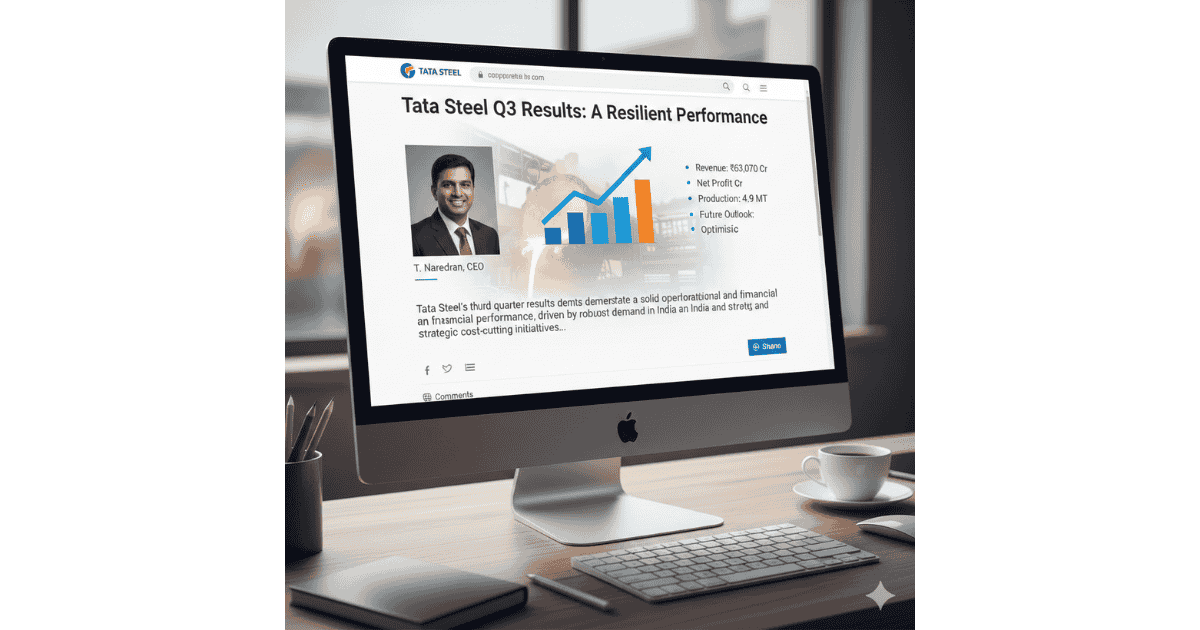
Tata Steel reported a sharp improvement in quarterly profitability as margins expanded across its domestic operations. The results reflect lower input costs, improved product mix, and early stabilization in global steel markets, signaling a potential cyclical recovery across the metals sector.
• Revenue: ₹55,312 crore
• EBITDA: ₹6,240 crore
• Net profit: ₹2,160 crore
• EBITDA margin: 11.3%
• India operations: Core earnings driver
Table of Contents
- Key Highlights
- Financial Performance
- Segment Performance
- India Operations Analysis
- Europe Operations Analysis
- Margin and Cost Trends
- Steel Price and Realization Dynamics
- Volume and Production Trends
- Balance Sheet and Debt Position
- Capital Allocation and Capex
- Capital-Flow and Institutional Impact
- Valuation Context
- Steel Cycle and Sector Context
- Global Steel Market Comparison
- Institutional Positioning
- Domestic Infrastructure Demand Impact
- Input Cost Cycle Analysis
- Multi-Year Margin Trend
- Capacity Expansion Strategy
- Peer Comparison: JSW Steel and Global Majors
- Policy and Trade Environment
- Key Risks
- Outlook
Key Highlights
- Quarterly net profit increased sharply year-on-year.
- EBITDA rose due to margin expansion in India operations.
- Lower coking coal costs supported profitability.
- European operations showed early stabilization.
- Results signal early stages of steel cycle recovery.
Tata Steel Q3 Results FY26: Financial Performance
| Metric | Q3 FY26 | Q3 FY25 | YoY Change |
|---|---|---|---|
| Revenue | ₹55,312 crore | ₹55,910 crore | Flat |
| EBITDA | ₹6,240 crore | ₹5,430 crore | +15% |
| Net profit | ₹2,160 crore | ₹522 crore | Sharp rise |
| EBITDA margin | 11.3% | 9.7% | Expansion |
Despite relatively stable revenue, EBITDA rose due to improved operating margins. The profit surge reflects stronger domestic performance and lower input costs.
Tata Steel Q3 Results FY26: Segment Performance
India Operations
- Primary contributor to earnings.
- Margin expansion supported by lower input costs.
- Stable demand from infrastructure and auto sectors.
Europe Operations
- Demand environment remained weak.
- Energy cost pressures persisted.
- Restructuring and cost optimization underway.
Tata Steel Q3 Results FY26: India Operations Analysis
India remains the core profit engine for Tata Steel. Domestic operations benefited from stable infrastructure demand, improved product mix, and lower coking coal prices. Higher capacity utilization further improved operating leverage.
The India business continues to deliver significantly higher margins compared to international operations, reinforcing its strategic importance.
Tata Steel Q3 Results FY26: Europe Operations Analysis
European operations have faced structural challenges due to weak demand and elevated energy costs. However, the quarter showed early signs of stabilization. Ongoing restructuring initiatives aim to improve cost efficiency and profitability.
Tata Steel Q3 Results FY26: Margin and Cost Trends
EBITDA margins improved due to:
- Lower coking coal prices.
- Improved product mix.
- Operational efficiencies.
The margin recovery suggests the early phase of a cyclical upturn in the steel sector.
Steel Price and Realization Dynamics
Steel realizations remained stable during the quarter. Domestic demand from infrastructure, construction, and automotive sectors supported pricing levels.
Volume and Production Trends
Production volumes remained stable, supported by strong domestic demand. Higher capacity utilization improved operating leverage and margins.
Balance Sheet and Debt Position
- Sequential reduction in net debt.
- Improved leverage ratios.
- Strong liquidity profile.
Debt reduction remains a strategic priority, particularly after the high leverage seen during earlier steel downcycles.
Capital Allocation and Capex
The company continues to focus on:
- Capacity expansions in India.
- Value-added steel products.
- Operational efficiency initiatives.
Capital-Flow and Institutional Impact
Strong earnings from a large-cap steel producer often trigger institutional capital rotation into cyclical sectors. Improved profitability may support flows into metals, capital goods, and infrastructure-linked stocks.
Valuation Context
Steel companies trade in cyclical valuation bands influenced by:
- Global steel prices.
- Input cost cycles.
- Capacity utilization levels.
Margin recovery phases often trigger valuation re-rating.
Steel Cycle and Sector Context
Steel earnings cycles are driven by:
- Global steel price trends.
- Domestic infrastructure demand.
- Raw material cost cycles.
- Capacity utilization.
The current quarter reflects early margin recovery.
Global Steel Market Comparison
Compared with global peers:
- Tata Steel benefits from strong domestic demand exposure.
- India operations deliver higher margins.
- European operations remain cyclical.
Institutional Positioning
Institutional investors typically increase allocations to metals when:
- Margins expand.
- Steel prices stabilize.
- Infrastructure spending rises.
Domestic Infrastructure Demand Impact
Infrastructure spending remains a major driver of steel demand in India. Government capex programs, construction activity, and industrial expansion support long-term consumption growth.
Input Cost Cycle Analysis
Steel profitability is heavily influenced by raw material prices, especially coking coal and iron ore. The quarter benefited from lower input costs, supporting margin expansion.
Multi-Year Margin Trend
Steel companies typically experience multi-year margin cycles. Periods of input cost inflation are followed by stabilization and margin recovery phases.
Capacity Expansion Strategy
Tata Steel’s long-term strategy focuses on:
- Expanding domestic steel capacity.
- Increasing value-added product share.
- Improving operational efficiency.
Peer Comparison: JSW Steel and Global Majors
Compared with peers:
- Tata Steel benefits from diversified geographic exposure.
- Domestic operations provide margin stability.
- European assets add cyclical risk.
Policy and Trade Environment
Global steel markets are influenced by:
- Trade tariffs and anti-dumping measures.
- Import restrictions.
- Domestic policy interventions.
Key Risks
- Volatility in global steel prices.
- High energy costs in Europe.
- Input cost inflation.
- Global demand slowdown.
Outlook
Tata Steel’s near-term performance will depend on:
- Global steel price trends.
- Domestic infrastructure demand.
- Input cost movements.
- European restructuring progress.
The company remains positioned as a key cyclical steel player benefiting from domestic demand growth.
Tata Steel Outlook: Steel Prices, Demand Cycles, and FY26 Margin Drivers
Tata Steel’s outlook for FY26 will depend on global steel prices, domestic infrastructure demand, and cost movements across raw materials. As one of India’s largest steel producers, the company’s earnings are closely tied to both domestic construction activity and international steel cycles.
1) Domestic Infrastructure and Capex Demand
India’s ongoing infrastructure push across:
Railways
Roads
Urban housing
Renewable energy projects
is expected to support steady domestic steel demand. Strong order books in construction and engineering sectors provide visibility for volume growth.
2) Global Steel Price Trends
International steel prices influence realizations, especially for export-linked businesses. Any recovery in global prices, particularly in Europe and Asia, can improve blended realizations for Tata Steel.
3) Raw Material Cost Movements
Key inputs such as:
Iron ore
Coking coal
Energy costs
have a direct impact on margins. A decline in coking coal prices or stable iron ore costs can support EBITDA margins over the coming quarters.
4) European Operations and Restructuring
Performance of the European business remains an important earnings variable. Cost optimization, restructuring initiatives, and demand recovery in Europe will be critical for margin stability.
5) Capacity Expansion and Efficiency Gains
Ongoing capacity expansions and operational efficiency programs are expected to:
Improve cost competitiveness
Increase domestic market share
Support long-term volume growth
6) Balance Sheet and Cash Flow Focus
Management continues to prioritize:
Debt reduction
Free cash flow generation
Capital discipline
A stronger balance sheet improves resilience during steel price cycles.
Overall, Tata Steel’s FY26 outlook will depend on the balance between global steel price trends, domestic infrastructure demand, and raw material cost movements.
Internal Links
External Sources
About The Author