JSW Steel Q3 Results FY26: Profit at ₹2,410 Crore as Record Volumes Signal Steel Cycle Stabilization

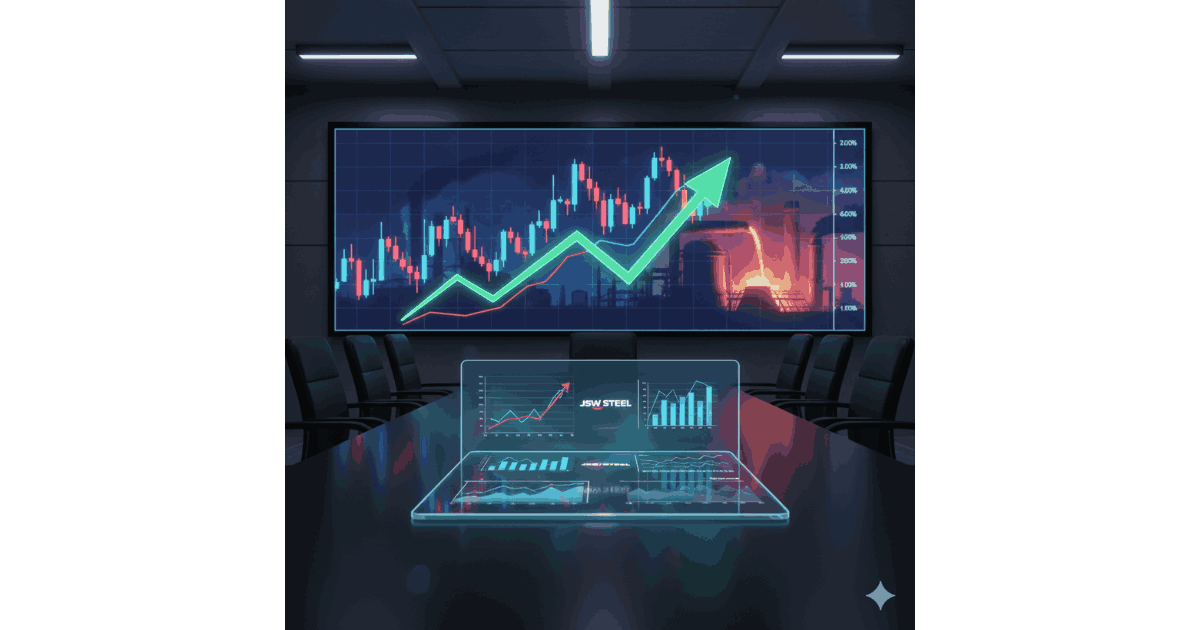
JSW Steel reported strong operating performance in the December quarter, with record sales volumes and improved EBITDA driven by higher domestic demand and lower coking coal costs. The results reflect early stabilization in the steel cycle and continued infrastructure-led demand across the Indian economy.
• Revenue: ₹45,991 crore
• Reported EBITDA: ₹6,496 crore
• Adjusted EBITDA: ₹6,620 crore
• EBITDA margin: 14.4%
• Net profit: ₹2,410 crore
• Steel sales: 7.64 million tonnes (record high)
Table of Contents
- Key Highlights
- Financial Performance
- Nine-Month Performance
- Volume and Production Trends
- Domestic Market Performance
- Export Trends
- Margin and Cost Analysis
- Segment and Subsidiary Performance
- Balance Sheet and Debt Position
- Capital Expenditure and Expansion Plans
- Energy Transition Strategy
- Capital-Flow and Institutional Impact
- Valuation Context
- Steel Cycle and Sector Context
- Domestic Steel Demand Cycle
- Raw Material Cost Cycle
- Multi-Year Volume and Capacity Growth
- Capital Structure and Deleveraging Strategy
- Peer Comparison: Tata Steel and Global Majors
- Institutional Allocation Patterns
- Policy and Trade Environment
- Key Risks
- Outlook
Key Highlights
- Net profit stood at ₹2,410 crore for Q3 FY26.
- Revenue reported at ₹45,991 crore.
- Adjusted EBITDA rose 22% year-on-year.
- Highest ever quarterly steel sales at 7.64 million tonnes.
- Domestic sales grew 10% year-on-year.
JSW Steel Q3 Results FY26: Financial Performance
| Metric | Q3 FY26 |
|---|---|
| Revenue | ₹45,991 crore |
| Reported EBITDA | ₹6,496 crore |
| Adjusted EBITDA | ₹6,620 crore |
| EBITDA Margin | 14.4% |
| Net Profit | ₹2,410 crore |
EBITDA improved due to higher steel volumes and lower coking coal and power costs, partially offset by softer steel realizations.
JSW Steel Q3 Results FY26: Nine-Month Performance
For the nine-month period, the company reported strong volume growth and stable operating margins, reflecting resilient domestic demand.
- Crude steel production: Up year-on-year.
- Sales volumes: Continued growth across domestic markets.
JSW Steel Q3 Results FY26: Volume and Production Trends
- Crude steel production: 7.48 million tonnes, up 6% YoY.
- Steel sales: 7.64 million tonnes, highest ever quarterly sales.
- Domestic sales: 6.59 million tonnes, up 10% YoY.
- Exports: 0.84 million tonnes, up 53% YoY.
Domestic Market Performance
India remained the primary growth engine during the quarter, with domestic steel consumption rising 4.6% year-on-year.
The company benefited from strong demand across infrastructure, construction, and capital goods sectors.
Export Trends
Exports rose sharply during the quarter, increasing 53% year-on-year.
Margin and Cost Analysis
Adjusted EBITDA rose 22% year-on-year, driven by:
- Higher steel volumes.
- Lower coking coal costs.
- Reduced power costs.
JSW Steel Q3 Results FY26: Segment and Subsidiary Performance
Indian Operations
- Crude steel production: 7.28 million tonnes, up 7% YoY.
- Capacity utilization: ~93%.
Bhushan Power & Steel
- Production: ~1 million tonnes.
- Adjusted EBITDA: ₹911 crore.
Balance Sheet and Debt Position
- Net debt: ₹80,347 crore.
- Net debt to equity: 0.92x.
- Net debt to EBITDA: 2.91x.
Capital Expenditure and Expansion Plans
- Q3 capex: ₹3,482 crore.
- 9M FY26 capex: ₹10,018 crore.
- FY26 capex guidance: ₹15,000–16,000 crore.
Energy Transition Strategy
- Approved renewable capacity: 2.5 GW.
- Operational renewable capacity: 1 GW.
Capital-Flow and Institutional Impact
Strong volume growth and stable margins indicate early stabilization in the steel cycle. Large-cap steel earnings often trigger institutional capital rotation into metals, infrastructure, and capital goods sectors.
Valuation Context
Steel companies trade in cyclical valuation bands influenced by:
- Global steel prices.
- Raw material cost cycles.
- Capacity utilization.
Steel Cycle and Sector Context
Steel earnings cycles are driven by global demand, infrastructure spending, raw material costs, and capacity utilization levels.
Domestic Steel Demand Cycle
Domestic demand is driven by:
- Infrastructure spending.
- Construction activity.
- Automobile production.
- Capital goods demand.
Raw Material Cost Cycle
Steel profitability is heavily influenced by coking coal and iron ore prices. Lower coking coal costs during the quarter supported margin expansion.
Multi-Year Volume and Capacity Growth
JSW Steel’s long-term strategy focuses on expanding domestic capacity to capture infrastructure-led demand growth.
Capital Structure and Deleveraging Strategy
The company continues to focus on reducing leverage through operating cash flows and disciplined capex.
Peer Comparison: Tata Steel and Global Majors
Compared with peers, JSW Steel benefits from:
- Higher domestic demand exposure.
- Volume-driven growth model.
- Expansion-led earnings strategy.
Institutional Allocation Patterns
Institutional investors typically increase allocations to steel stocks when:
- Volumes rise.
- Margins stabilize.
- Infrastructure demand increases.
Policy and Trade Environment
Global steel markets are influenced by trade tariffs, anti-dumping measures, and domestic policy interventions.
Key Risks
- Steel price volatility.
- Input cost inflation.
- Global demand slowdown.
- Trade policy changes.
Outlook
JSW Steel’s near-term performance will depend on domestic infrastructure demand, global steel prices, and input cost movements.
With record volumes and improving margins, the company remains positioned as a key beneficiary of India’s steel demand cycle.
Internal Links
External Sources
About The Author