
Main takeaway: The Aequs IPO is a ₹921.81 crore main-board issue in The Aequs IPO, which is part of the aerospace and precision manufacturing sector, is priced at ₹118–₹124 per share with a lot size of 120 shares, and it will be open from 3 to 5 December 2025. upcycle but comes with high customer concentration, sector cyclicality, and loss-making financials, making it better suited for informed, long-term investors rather than pure listing-gain hunters.
Aequs IPO 2025: Quick Aequs IPO snapshot (snippet-ready)
Question: What are the key details of the Aequs IPO 2025?
Answer:
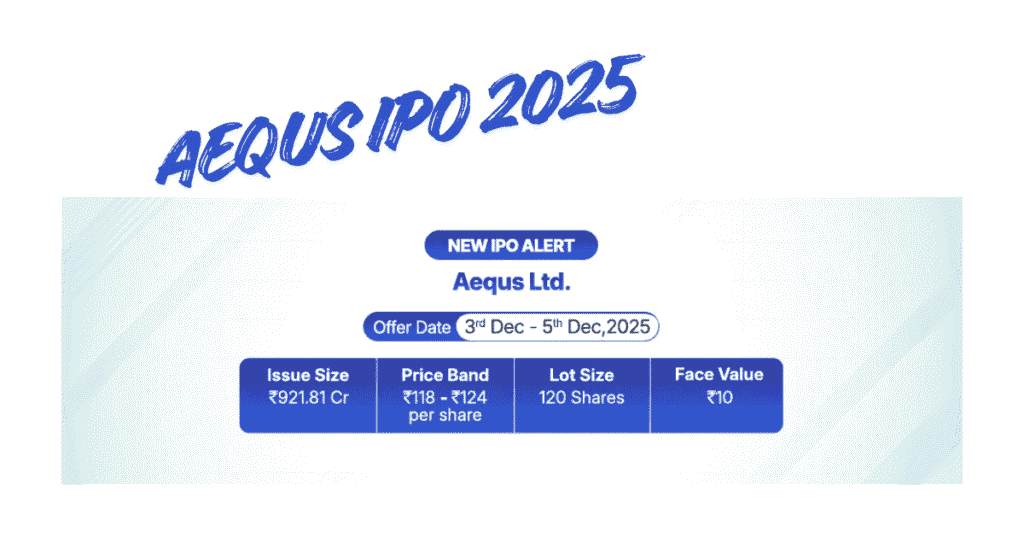
The Aequs IPO is a ₹921.81 crore book-built issue with a price band of ₹118–₹124 per share, a lot size of 120 shares, opening from 3–5 December 2025, with tentative listing on 10 December on NSE and BSE.
Aequs IPO 2025 details: dates, price band, lot size, and issue structure
For investors searching “Aequs IPO price band and lot size” or “Aequs IPO issue size,” here are the exact numbers.
Issue structure and size:
- Total issue size:
₹921.81 crore - Fresh issue:
₹670.00 crore (5.40 crore shares) - Offer for sale (OFS):
₹251.81 crore (2.03 crore shares) - Issue type:
Mainboard, 100% book-built - Face value:
₹10 per share
Aequs IPO price band and lot size:
- Price band:
₹118–₹124 per share - Lot size:
120 shares - Minimum retail investment (1 lot):
₹14,880 (at ₹124) - Maximum retail (13 lots):
1,560 shares ≈ ₹193,440 - sNII minimum (14 lots):
1,680 shares ≈ ₹208,320 - bNII minimum (68 lots):
8,160 shares ≈ ₹1,011,840
Important Aequs IPO dates:
- IPO open:
3 December 2025 - IPO close:
5 December 2025 - Basis of allotment:
8 December 2025 (tentative) - Credit to Demat/refunds:
9 December 2025 - Listing date (BSE & NSE):
10 December 2025 (tentative)
Reservation structure follows the standard main-board split:
- QIB:
Not less than 75% of net offer - NII:
Not more than 15% - Retail:
Not more than 10%
Aequs business model: integrated aerospace + diversified precision manufacturing
Aequs Limited is positioned as a diversified precision manufacturing company with a core focus on aerospace components, built around its integrated aerospace ecosystem SEZ at Belagavi, Karnataka.
Key business segments:
- Aerospace manufacturing (core)
- Engine components, landing gear, and structural parts
- Cargo interiors, actuation systems, and assemblies
- Supplies to major global programs such as A220, A320, B737, A330, A350, B777, and B787
- Consumer electronics and plastics
- Precision plastics and assemblies for global consumer brands
- Electronics and appliance components
- Consumer durable components
- Contract manufacturing for leading OEMs in durables, using the same cluster-based infrastructure
The company operates manufacturing ecosystems across Belagavi (aerospace), Hubballi (consumer electronics and durables), and Koppal (plastics), along with facilities in France and the US, creating a global footprint and shorter supply chains for OEMs.
This integrated cluster model allows Aequs to offer “one-stop-shop” solutions from machining and forging to surface treatment and final assembly, a key differentiator versus smaller single-process suppliers.
Sector exposure, customer concentration, and growth opportunity
From an investor’s perspective, Aequs is effectively a high-beta play on global aerospace and defense manufacturing.
Revenue mix and dependence:
- Aerospace contributed 88.23% of net external revenue in H1 FY26.
- The top 10 clients accounted for 82.51% of revenue, and the top 5 for 66.36%.
This concentration has two sides:
- Positive:
- Deep integration in global aerospace supply chains
- Longstanding relationships with blue-chip OEMs like Airbus, Boeing, Safran, Spirit AeroSystems, Eaton, and Collins Aerospace
- High switching costs and qualification barriers for new entrants
- Negative:
- Loss of one large client can materially impact revenue and cash flows.
- No minimum order commitments, so production schedules can be volatile
- High dependence on a cyclical, export-driven sector (aviation, defense, global macro)
For example, revenue contribution from Hasbro in the consumer segment dropped sharply from 17.63% in FY23 to 4.63% in September 2025, illustrating the volatility of certain client relationships.
Aequs IPO 2025: Financial performance and key metrics
Aequs is not coming to the market as a straightforward profit-compounding story. Investors searching for “Aequs IPO valuation” or “Aequs IPO financials” need to appreciate that the company is still loss-making.
Consolidated financials (₹ crore):
| Metric | FY23 | FY24 | FY25 |
|---|---|---|---|
| Total income | 840.54 | 988.30 | 959.21 |
| EBITDA | 63.06 | 145.51 | 107.97 |
| Net profit/(loss) | -109.50 | -14.24 | -102.35 |
| Total assets | 1,321.69 | 1,822.98 | 1,859.84 |
| Net worth | 251.91 | 807.17 | 707.53 |
| Total borrowings | 346.14 | 291.88 | 437.06 |
Key ratios (as of FY25):
- ROE:
-14.30 - ROCE:
0.87 - Debt/Equity:
0.99 - PAT margin:
-11.07% - EBITDA margin:
11.68% - Price-to-book (P/B):
~9.94 - Market cap at upper band:
≈₹8,316 crore
JM Financial notes that revenue fell ~3% and PAT worsened sharply between FY24 and FY25, indicating earnings volatility. Capacity underutilization, especially at the US aerospace facility (only around 14–15% utilized), and slowdown in the consumer segments have weighed on profitability.
Implication for investors:
Valuations embed high expectations of future margin expansion and better utilization. This suits investors comfortable with early-stage, capex-heavy industrial stories but is risky for those seeking steady earnings visibility.
Aequs IPO 2025: Use of IPO proceeds: deleveraging plus capex
How Aequs plans to use the fresh issue of ₹670 crore is central to the long-term thesis.
Planned utilization of net proceeds:
- Repayment/prepayment of borrowings:
- Around ₹433.17 crore across Aequs and three wholly owned subsidiaries (AeroStructures Manufacturing India, Aequs Consumer Products, and Aequs Engineered Plastics).
- Expected to improve leverage, reduce interest costs, and strengthen the balance sheet.
- Capital expenditure on machinery and equipment:
- About ₹64 crore, including investment in AeroStructures Manufacturing India, is focused on high-precision aerospace capability expansion.
- Inorganic growth & strategic initiatives:
- Aequs has allocated funds for unidentified acquisitions and strategic projects, which will enable it to progress up the value chain and strengthen its customer relationships.
- General corporate purposes:
- Working capital, cluster expansion, and other corporate needs.
For long-term investors, this mix of deleveraging and growth capex is positive, provided execution is disciplined and utilization ramps up as planned.
Aequs IPO 2025: GMP today and listing gain expectations
Many traders search for “Aequs IPO GMP today” to gauge listing gain potential. As of the latest available reports:
- The Aequs IPO grey market premium (GMP) is reported around ₹43–₹44 per share, implying a 35% premium over the upper price band of ₹124.
- This translates to an indicative listing price in the ₹167–₹168 range, though GMP can change quickly as subscription data and market sentiment evolve.
Broker commentary and grey market trends signal strong early demand, aided by marquee pre-IPO and anchor investors such as Amicus Capital, Amansa Capital, Catamaran (N. R. Narayana Murthy’s family office), and Sparta Group.
Important caution:
GMP is unofficial, unregulated, and purely indicative. It should be used only as a sentiment gauge, not as a guarantee of listing gains. Fundamental valuation, risk profile, and portfolio fit should remain the primary drivers of your decision.
Should you subscribe to the Aequs IPO? Key strengths vs. risks
For queries like “Aequs IPO subscribe or avoid” or “Is Aequs IPO good for the long term?”, consider the following balanced view.
Major strengths:
- Unique integrated aerospace ecosystem at Belagavi SEZ, offering end-to-end manufacturing (machining, forging, treatment, assembly) from a single cluster.
- High entry barriers due to certifications, long qualification cycles, and deep relationships with global OEMs and Tier-1 suppliers.
- Diverse precision manufacturing capabilities, expanding beyond aerospace into consumer electronics, plastics, and durables.
- Sector tailwinds from rising global aircraft orders, defense localization, and “China+1” sourcing benefiting Indian manufacturers.
- Post-IPO deleveraging and capex can improve margins and return ratios over the medium term if utilization improves.
Key risks and concerns:
- Loss-making track record with negative ROE and PAT margin; profitability has been volatile and sensitive to utilization.
- High customer concentration (top 10 clients contributing over 80% of revenue), making the business vulnerable to order cuts or relationship shifts.
- Heavy dependence on aerospace, a cyclical and capital-intensive sector, with sensitivity to global aviation and defense cycles.
- Low utilization in certain facilities (for example, US aerospace plants), which depresses margins until volumes scale up.
- Rich valuation multiples, with a market cap of ~₹8,300+ crore despite negative earnings, implying that future growth is already priced in to some extent.
Who may consider the Aequs IPO?
- Investors with a high risk appetite, seeking exposure to India’s emerging aerospace and precision engineering story.
- Long-term investors are comfortable with 3–5+ year holding periods and willing to wait for capacity ramp-up and margin expansion.
- Those who understand that the IPO is not a low-risk, profit-stable manufacturing play, but a leveraged bet on sector and execution.
Conservative retail investors or those focused purely on safe listing gains may prefer to apply with smaller amounts or even watch post-listing price action before committing bigger capital.
How to apply for Aequs IPO online (step-by-step)
For “how to apply for Aequs IPO online” and similar high-intent searches, here is a simple, platform-agnostic process using UPI/ASBA.
Step 1: Prepare your account and funds.
- Ensure you have an active Demat and trading account and a UPI ID linked to your bank.
- Maintain at least ₹15,000–₹16,000 in your bank account to comfortably apply for 1 lot at the upper price band.
Step 2: Go to the IPO section on your broker or bank.
- Log in to your discount broker (e.g., Zerodha, Upstox, etc.) or net banking (ASBA).
- Navigate to the IPO/Invest → IPO section.
- Select “Aequs Limited IPO” from the list of open issues.
Step 3: Enter bid details.
- Choose the investor type (Retail / HNI).
- Enter number of lots (1–13 for retail).
- For better allotment probability, select “Cut-off price” rather than manually entering a price.
Step 4: confirm and approve the UPI mandate.
- Submit the application and then open your UPI app (BHIM, PhonePe, Google Pay, etc.).
- Please approve the mandate request before the cut-off time (5 PM, 5 December 2025).
- Ensure you do not cancel the mandate; funds will be blocked and debited only if you receive allotment.
Step 5: Track allotment and listing
- Check the Aequs IPO allotment status on your broker app or the registrar’s website (Kfin Technologies) on or after 8 December 2025.
- If allotted, shares should appear in your Demat by 9 December; you can then trade from the listing day (10 December).
Actionable strategy tips for Aequs IPO investors
To convert traffic from “Aequs IPO listing gain strategy” and “Aequs IPO long-term view” into engaged readers, offer clear, practical guidance.
1. Position sizing and risk control
- Treat Aequs as a high-risk, high-potential satellite allocation, not a core portfolio holding.
- Limit exposure to a small percentage of your equity portfolio, especially if you already hold cyclical or defensive names.
- Avoid leveraging or using borrowed funds; valuations already embed optimism.
2. Different strategies for traders vs. investors
- For listing-gain traders:
- Track GMP, subscription levels (especially QIB and NII), and overall market sentiment up to the final day.
- Be mentally prepared for volatility on listing day; have clear exit levels rather than chasing momentum blindly.
- For long-term investors:
- Focus on order book, capacity utilization, margin trajectory, and debt reduction over the next 4–6 quarters.
- Consider a staggered approach: apply modestly in the IPO and add or reduce exposure based on post-listing price and earnings delivery.
3. Key data to monitor post-listing
- Quarterly EBITDA margin trends and impact of debt repayment on interest cost.
- Utilization ramp-up in US and Indian facilities, especially in high-margin aerospace work.
- The company has secured new program wins with prestigious original equipment manufacturers (OEMs) and is diversifying its client base to reduce concentration risk.
FAQs on Aequs IPO (for featured snippets)
Q1. What is the Aequs IPO price band?
The Aequs IPO price band is ₹118–₹124 per share with a face value of ₹10.
Q2. What is the Aequs IPO lot size for retail investors?
The minimum lot size is 120 shares, requiring an investment of ₹14,880 at the upper band.
Q3. What are the Aequs IPO open and close dates?
Aequs IPO opens on 3 December 2025 and closes on 5 December 2025, with tentative listing on 10 December 2025 on BSE and NSE.
Q4. What is the Aequs IPO GMP today?
Recent reports indicate an unofficial GMP of about ₹43–₹44 per share, implying a potential 35% listing premium, but this is not guaranteed and can change quickly.
Q5. Is the Aequs IPO good for long-term investment?
Aequs offers a unique aerospace manufacturing play with strong sector tailwinds and marquee clients, but it remains loss-making with high customer concentration and rich valuations, making it more suitable for high-risk, long-term investors who understand cyclical industrial stories.
Internal and external link suggestions
- Internal links:
- From early in the article:
“If you are new to IPO analysis, first read our detailed guide on how to analyze an IPO before investing for a step-by-step framework.” - In the conclusion:
“Also explore our latest coverage on Vidya Wires IPO review and other upcoming main-board issues for more manufacturing-sector ideas.”
- From early in the article:
- Authoritative external source:
- Link once to the official Aequs Limited Red Herring Prospectus (RHP) on the NSE/BSE or SEBI website as the primary source for risk factors, financial statements, and detailed disclosures.
READ MORE: Vidya Wires IPO Review 2025: GMP, Price Band, Financials & Should You Invest?
Aequs IPO 2025: Final verdict: Should you chase the IPO or wait?
Aequs IPO stands at the intersection of several powerful themes: Make in India, aerospace localization, precision manufacturing, and global supply chain diversification. The company’s integrated SEZ-based model, long-standing OEM relationships, and capex-backed growth roadmap make it a compelling structural story on paper.
However, its loss-making financials, high customer and sector concentration, low utilization of key assets, and premium valuation mean that the margin for execution error is limited. This is not a safe, cash-rich compounder at listing; it is a high-conviction, high-volatility bet on management’s ability to convert capacity and relationships into sustainable profitability.
For readers of your site, the most balanced approach is
- Use modest position sizing if applying in the IPO.
- Treat any listing gains as a bonus, not the sole reason to invest.
- Continue tracking post-listing earnings, margins, and order flows before scaling exposure.
To deepen understanding, readers should next move to:
- The core framework article on IPO evaluation, which covers business quality, valuation, growth, and risk, is a good place to start.
- Recent analyses of other manufacturing and defense-linked IPOs like Vidya Wires, to compare valuations, balance sheets, and risk profiles.
This way, the Aequs IPO blog not only answers immediate “apply or avoid” questions but also nudges visitors to stay longer, explore related content, and build a more systematic, data-driven approach to IPO investing.