


Auto Sector: Earnings, Policy, and Capital Flows
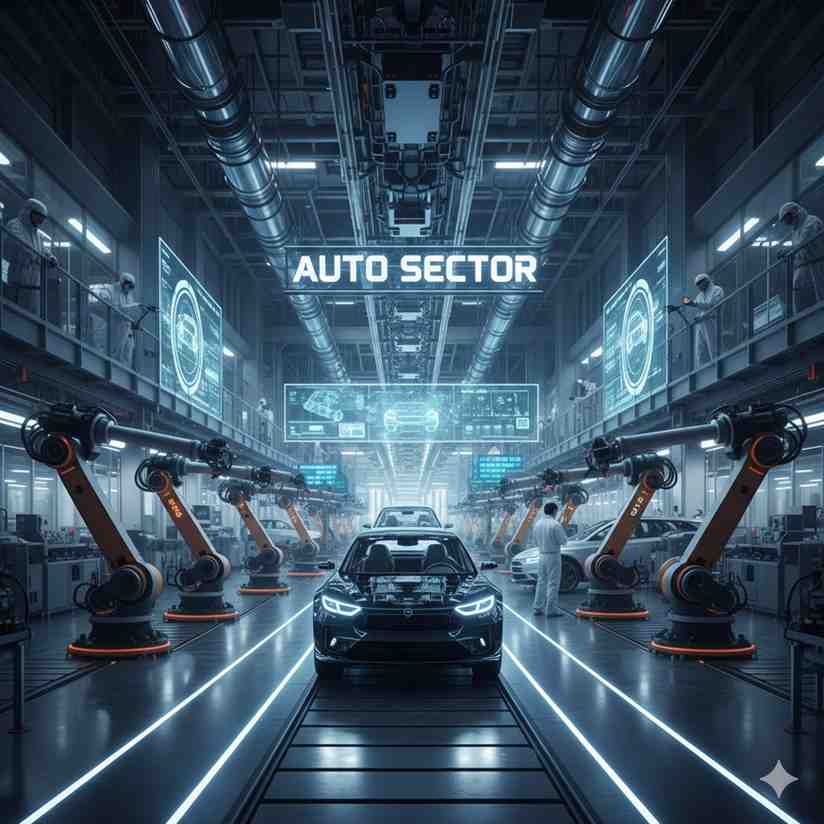
The auto sector reflects consumer demand, industrial activity, and credit availability, making it a key cyclical driver of capital flows in the equity market.
The auto sector acts as a real-time indicator of economic momentum, reflecting trends in consumption, infrastructure spending, freight demand, and credit growth. Movements in passenger vehicle, two-wheeler, tractor, and commercial vehicle sales directly influence institutional capital allocation across cyclical stocks.
Auto Sector Snapshot
| Indicator | Current Trend |
|---|---|
| Passenger Vehicle Demand | Stable with premium segment growth |
| Commercial Vehicle Cycle | Supported by infrastructure and freight demand |
| Rural Demand | Gradual recovery with tractor and entry-level vehicles |
| Electric Vehicle Adoption | Rising across two-wheelers and urban segments |
Table of Contents
- Sector Overview
- Auto Demand and Economic Cycles
- Passenger vs Commercial Vehicle Dynamics
- Rural and Urban Demand Drivers
- Major Auto Earnings Anchors
- Policy and Regulatory Drivers
- Capital-Flow Impact
- Valuation Context
- Key Risks
- Outlook
Sector Overview
The automobile sector is one of the largest contributors to India’s manufacturing output and employment. It spans passenger vehicles, two-wheelers, commercial vehicles, tractors, and auto components.
Auto stocks are considered cyclical, with performance closely tied to interest rates, fuel prices, income growth, and infrastructure spending.
Auto Demand and Economic Cycles
Vehicle demand typically follows economic cycles. During periods of rising income and credit availability, passenger vehicle and two-wheeler sales increase.
Commercial vehicle demand is closely linked to freight activity, infrastructure spending, and industrial output.
- Passenger vehicles reflect urban consumption trends
- Two-wheelers indicate rural income strength
- Commercial vehicles track industrial and infrastructure cycles
- Tractors reflect agricultural income and monsoon trends
Passenger vs Commercial Vehicle Dynamics
Passenger vehicles are primarily driven by consumer sentiment, financing availability, and urban income growth.
Commercial vehicles, on the other hand, depend on freight demand, infrastructure projects, and replacement cycles.
Premium segments have shown stronger growth compared with entry-level models, reflecting income stratification across urban consumers.
Rural and Urban Demand Drivers
Urban demand is influenced by employment, income growth, and financing availability, while rural demand depends on agricultural output, monsoon performance, and government support schemes.
Tractor and entry-level two-wheeler demand often act as indicators of rural economic conditions.
Major Auto Earnings Anchors
Policy and Regulatory Drivers
The auto sector is influenced by fuel prices, emission norms, interest rates, and government incentives.
- Interest rate cycles affecting auto loan demand
- Emission regulations impacting vehicle costs
- Electric vehicle incentives and subsidies
- Infrastructure spending supporting CV demand
Capital-Flow Impact
The auto sector attracts institutional capital during economic upcycles, when consumption and infrastructure demand strengthen.
- Passenger vehicle leaders attract defensive consumption flows
- Commercial vehicle companies reflect capex cycles
- Premium motorcycle and SUV segments attract growth capital
Valuation Context
Auto companies are typically valued based on volume growth, operating margins, product mix, and capital efficiency.
Premium segments and companies with strong pricing power often command higher valuation multiples.
Key Risks
- Rising interest rates affecting vehicle financing
- Commodity price volatility impacting margins
- Fuel price increases reducing demand
- Regulatory changes in emission norms
Outlook
The auto sector outlook remains linked to income growth, credit availability, and infrastructure spending. Premium passenger vehicles and commercial vehicles are expected to remain key growth drivers.
Institutional capital flows into auto stocks typically increase during economic upcycles, when freight demand, rural income, and urban consumption strengthen.
Future performance will depend on interest-rate trends, commodity costs, and the pace of electric vehicle adoption.
Related Sector Coverage
Official Sources
Shubham tracks Indian equity markets with a focus on banking stocks, insurance companies, and long-term value investing. PositionalCalls was built to give independent investors the same quality of research that institutional desks produce — in plain language, with no brokerage bias and no paid promotions. All analysis is sourced from RBI, SEBI, NSE/BSE filings, and company annual reports.