

Sector outlook · Jewellery
Looking for the jewellery sector outlook 2026? The February page called it a structurally positive demand cycle with five drivers and no figures. This rebuild tests each claim against World Gold Council demand data, the May import duty rise, gold prices, and the Q2 FY27 numbers of Titan, Kalyan Jewellers and Senco Gold. It sets out what to watch, not what to buy.
Quick answer
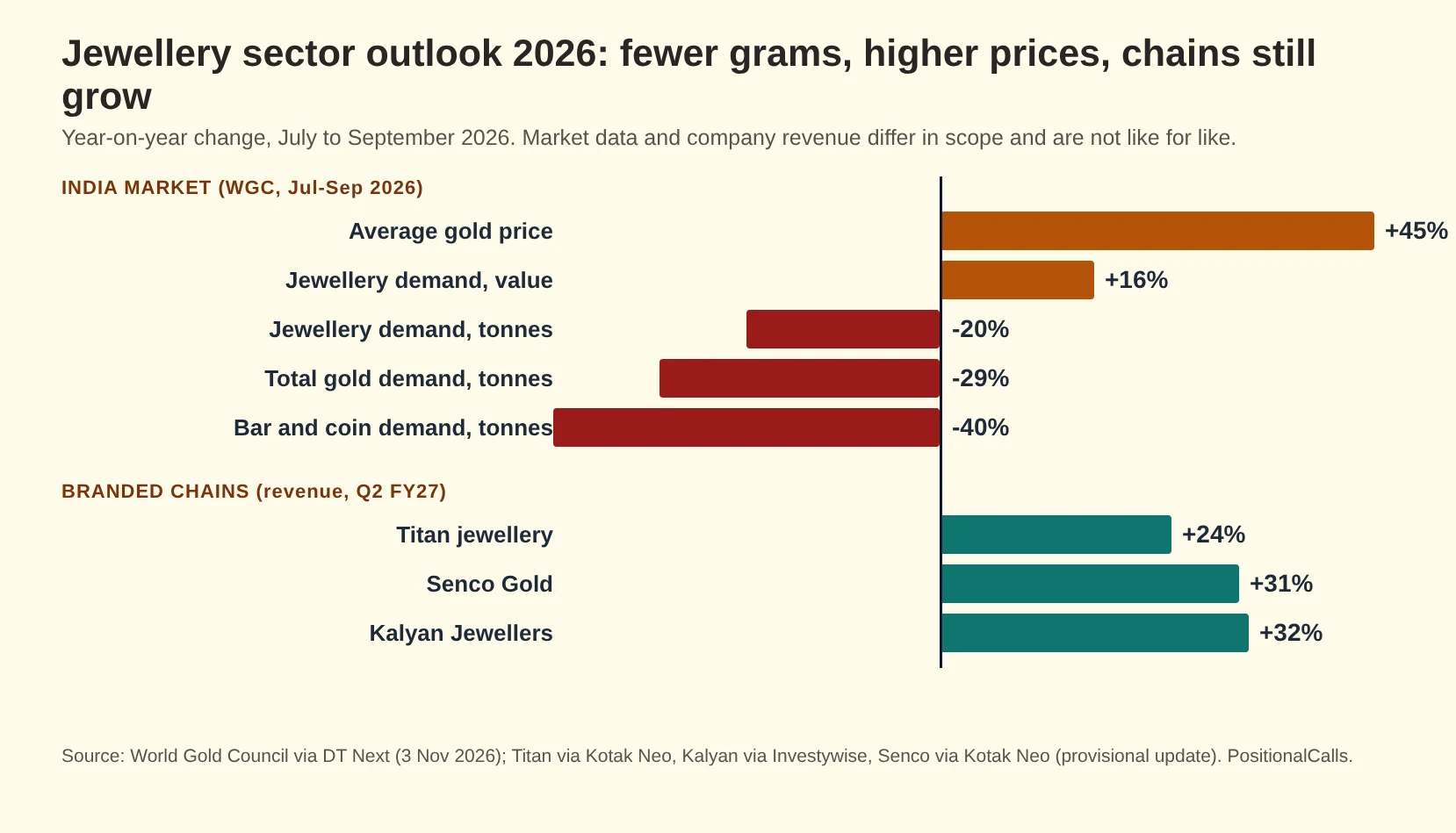
The jewellery sector outlook 2026 is mixed. India gold jewellery demand fell 20% in tonnes in Q3 as prices rose 45%, and import duty went to 15%, yet Titan, Kalyan and Senco grew revenue 24% to 32%. Growth is price-led, not volume-led. This page names no stock to buy.
Latest update (Sunday, 15 November 2026, 7:43 AM IST): Rebuilt on fresh data. The February page said gold-price moves would only temporarily affect demand and that margins would expand; since then the import duty rose from 6% to 15% on 13 May, India jewellery demand fell 20% in tonnes in Q3, and Titan’s reported margin gain came largely from a one-time duty benefit. I did not open the original reports or any filing, and I found no valuation or institutional flow data.
Key takeaways
- No stock is named: the February valuation, institutional positioning and capital-flow sections had no data and are not carried over. This page gives no rating, ranking or target.
- Volume fell, value rose: the World Gold Council reports India jewellery demand of 99.9 tonnes in Q3, down 20%, while its value rose 16% to Rs 1,48,700 crore, because the average gold price rose about 45%.
- Branded chains grew faster than the market: Titan jewellery revenue rose 24%, Senco 31% and Kalyan 32%, against about 16% growth in total jewellery value (a scope comparison, my calculation); Titan’s buyer count was flat.
- Policy turned: import duty on gold rose from 6% to 15% on 13 May 2026, official bullion imports fell 70% to 64 tonnes in Q3, and about 50 tonnes of unofficial inflows were estimated.
- Margin gains need a check: Titan’s domestic jewellery EBIT margin was 14.3% reported but 11.1% without a Rs 490 crore one-time duty benefit, against about 11.1% a year earlier (my calculation).
- Gaps: no valuation, no flow data, no Thangamayil or PN Gadgil results opened, and no filings read, so this page cannot say the sector is cheap or expensive.
In plain words: people are buying fewer grams of gold jewellery because gold costs about 45% more and the government raised the import duty. Big chains still grew sales by 24% to 32% because each sale is worth more. This page lays out the data and what would change the picture.
Data note: Demand data is from the World Gold Council Q3 2026 report as reported by DT Next (3 November 2026) and gold.org. Duty data is from Business Today (13 May 2026). Company data is from Kotak Neo, Multibagg, Investywise and Sahi summaries. Industry-source comments on festive sales are from Kotak Neo (30 September 2026) and are unnamed. I did not open the original reports or any BSE or NSE filing. Derived numbers are my calculation.
1. What changed in the jewellery sector outlook 2026 since February?
The jewellery sector outlook 2026 changed from a structural volume story to a price-led one: tonnes sold fell 20%, import duty rose to 15%, gold is far dearer, yet branded chains still grew revenue 24% to 32% in Q2 FY27.
The February version said wedding cycles, rising incomes and a shift to branded retail made the demand environment structurally positive, with accelerating store expansion and margin expansion from premium products. It said gold spikes would only temporarily affect demand. It had a “Snapshot FY26” table with no figures. Nine months later, the Q3 demand data, the May duty decision and the Q2 company numbers are out, so each claim can be tested.
What the jewellery sector outlook 2026 page tests
- Demand and gold price: World Gold Council data on tonnes, value and price (section 3).
- Policy: the May duty rise and its effects (section 4).
- Company results: Titan, Kalyan, Senco and what I could not find (section 5).
- Margins and stores: what drove profit and growth (sections 6 and 7).
- Season, macro and watch items: festive demand, inflation and conditions to check (sections 8 to 10).
I removed the “valuation and institutional positioning” and “capital-flow impact” sections. They described inflows with no figures, and I found no price, multiple or flow data to support them. The Tier-2 and Tier-3 expansion claim is partly tested in section 7 through store counts.
2. Old claims against the data in the jewellery sector outlook 2026
Of ten claims on the February jewellery sector outlook 2026 page, the data supports three, contradicts three, splits two and leaves two untested, so a purely positive outlook is not confirmed.
| February claim | What I found | Verdict |
|---|---|---|
| Wedding and festive cycles support demand | WGC expects festive and wedding demand to support Q4; industry sources expect value demand +20% to +25% but volumes -10% to -15% | Split |
| Branded jewellery gaining share | Titan +24%, Senco +31%, Kalyan +32% revenue against about +16% in total jewellery value; Titan buyers flat | Supported |
| Store expansion accelerating | Kalyan 246 FOCO showrooms with 84 planned in FY27; Senco 215 stores, 14 added in H1 | Supported |
| Premium mix lifts margins | Titan studded share 35% against 32%; but ex-duty domestic margin about flat at 11.1% | Split |
| Moderate gold rises support demand, spikes only temporarily affect it | Average price +45% year on year; India jewellery tonnes -20% | Contradicted |
| Stable inflation helps spending | CPI 6.09% in October, up from 4.45% in July | Contradicted |
| Sharp gold rise and tax changes are risks | Both occurred: price +45%, duty 6% to 15% on 13 May | Contradicted (risk has occurred) |
| Valuations elevated in high-growth names | No price or multiple data used | Untested |
| Institutional capital favours organised players | No flow data found | Untested |
| Strong growth momentum through FY26 | Q2 FY27 revenue growth 24% to 32% at three chains, but volumes lower | Supported on value only |
Cite this table: Claims per the February PositionalCalls page; evidence per the World Gold Council, Business Today, Kotak Neo and company summaries as reported; originals not opened.
The pattern is that the branded-share and store-expansion claims held up, while the claims about moderate gold prices and stable inflation did not. The February page called the sector structurally positive; the data shows a sector where sales rupees are growing and grams are shrinking. That is a different business to analyse. No stock view follows from this table.
3. Gold prices and demand in the jewellery sector outlook 2026
India gold demand fell 29% to 162.5 tonnes in July to September, with jewellery down 20% to 99.9 tonnes and bars and coins down 40%, while demand value rose 3% because the average price rose 45%, so the jewellery sector outlook 2026 is price-led.
| India, Q3 2026 (July to September) | Reading | Year on year |
|---|---|---|
| Total gold demand | 162.5 tonnes | -29% (from 229.8 tonnes) |
| Jewellery demand | 99.9 tonnes; value Rs 1,48,700 crore | -20% in tonnes; +16% in value |
| Bar and coin demand | 55 tonnes | -40% |
| Gold ETF demand | 5.3 tonnes | -50% |
| Average local gold price (MCX) | Rs 1,48,891 per 10 grams; US$4,262 per ounce | +45%; from Rs 1,02,287 and US$3,457 |
| Recycling | 19 tonnes | -12% |
| Official bullion imports | 64 tonnes; unofficial inflows estimated at about 50 tonnes | -70% |
| 2026 full-year demand forecast | 625 to 675 tonnes (WGC) | Described as a six-year low |
Cite this table: Data per the World Gold Council Q3 2026 report as reported by DT Next and gold.org; price figures exclude import duty and GST; originals not opened.
Demand fell in tonnes, but price rose so much that rupees spent on gold rose. WGC attributes the drop to higher import duty, soaring prices and the Prime Minister’s appeal to curb purchases, and notes that a late-quarter price pullback encouraged some deferred buying. Its Indian head, Sachin Jain, said consumers are choosing more considered purchases and exchange programmes. The gold price itself peaked above Rs 2 lakh per 10 grams in late January 2026 and had eased by Q3 (Kotak Neo). The IBJA 24-carat rate was Rs 1,41,062 per 10 grams on 4 November, before GST and making charges, which is below the Q3 average but is a different series. I make no price forecast.
4. Import duty and policy in the jewellery sector outlook 2026
The government raised the import duty on gold and silver from 6% to 15% on 13 May 2026, after the Prime Minister asked Indians to avoid buying gold for a year, and official bullion imports then fell 70% in Q3 while unofficial inflows rose.
| Policy item | Reading | Source |
|---|---|---|
| Import duty on gold and silver | Raised from 6% to 15% (10% basic customs duty plus 5% agriculture infrastructure cess) | Business Today, 13 May 2026 |
| Stated reason | Reduce reliance on overseas metal purchases and ease pressure on foreign exchange reserves | Business Today |
| Prime Minister’s appeal | Asked Indians to avoid buying gold for a year | Business Today |
| IBJA reaction | Duty raised to curb the current account deficit; demand could be affected because prices were already high | IBJA national secretary, as reported |
| Smuggling concern | A bullion dealer warned grey markets would likely become active again | Business Today, unnamed dealer |
| Official imports, Q3 | 64 tonnes, -70% year on year; unofficial inflows about 50 tonnes | WGC, as reported |
Cite this table: Policy data as reported by Business Today and the World Gold Council; the smuggling view is one unnamed dealer; originals not opened.
The February page listed regulatory or tax changes as a risk with no detail. The risk occurred: the duty more than doubled. The effects cut two ways. A higher duty raises the domestic gold price and lowers volumes, and retailers sitting on older, cheaper inventory can book a gain, which is what Titan’s results reported (section 6). The unofficial inflow estimate is a reminder that part of the market can route around the duty. That is a risk to organised retailers who price and certify transparently. See my consumption sector outlook 2026 and India CPI inflation October 2026 post for demand and inflation context.
5. Branded chain results in the jewellery sector outlook 2026
In Q2 FY27 Titan jewellery revenue rose 24% to Rs 17,495 crore, Kalyan revenue rose 32% with profit up 62%, and Senco revenue rose 31%, so branded chains outgrew the roughly 16% rise in total jewellery value.
| Company, Q2 FY27 | Revenue | Other data | Source |
|---|---|---|---|
| Titan (jewellery) | Rs 17,495 crore (+24%); India jewellery Rs 16,343 crore (+21%); international Rs 1,152 crore (+105%) | Total income Rs 20,533 crore (+25%); PBT Rs 2,329 crore (+53%) but +18% excluding a Rs 536 crore duty benefit | Kotak Neo, 6 November |
| Kalyan Jewellers | Rs 9,007 crore (+32%); India +32%; Middle East +11% | PAT Rs 424 crore (+62%) including a Rs 73.5 crore exceptional gain on non-core real estate; same-store sales about +20%; EBITDA Rs 548.5 crore (+27%) | Investywise, 10 November |
| Senco Gold | Total revenue +31%; retail +29%; first half +48% | Same-store sales +19%; diamond jewellery value +31%, volume +7%; business update, provisional | Kotak Neo, 7 October |
| Thangamayil | Not found for Q2 | August article: sales had not picked up in the first 28 days of Q2; Q1 profit Rs 85 crore (+86%) on revenue Rs 2,666.4 crore | NewsBytes, 3 August; Q2 results not found |
Cite this table: Company data as reported by the sources named; I did not open any filing; Senco is a provisional business update; the rows are not added because scope and period differ.
The comparison with the market is mine and rough: WGC reports total jewellery value up 16% for July to September, while three chains reported 24% to 32% revenue growth for the same quarter. Scopes differ, because WGC covers all gold jewellery by weight and value, and company figures include non-gold lines and, at Kalyan, the Middle East. It is consistent with share gains but is not proof. The volume side is clearer at Titan, where buyers were flat and growth came from higher ticket sizes (Multibagg), and at Senco, where diamond jewellery volume rose 7%, far above the 20% fall in tonnes for the whole market. See my Titan Q2 results FY27 and Kalyan Jewellers Q3 results FY26 post for earlier detail.
PositionalCalls WhatsApp channel
Track gold and demand data plainly
- Sector data without tips
- Gold demand and duty checks
- A message when this page is updated
6. Margins and the duty benefit in the jewellery sector outlook 2026
Titan reported domestic jewellery EBIT of 14.3% in Q2, but a Rs 490 crore one-time customs-duty benefit made up about 64% of the rise; without it the margin was 11.1%, about flat on a year earlier, so margin expansion is not yet shown.
| Titan jewellery, Q2 FY27 | Reported | Excluding duty benefit |
|---|---|---|
| Domestic jewellery (Tanishq, Mia, Zoya) EBIT | Rs 2,142 crore; 14.3% margin on Rs 14,935 crore revenue | Rs 1,652 crore; 11.1% margin |
| Domestic EBIT growth | +55.1% | About +20% |
| Year-ago domestic EBIT | Rs 1,381 crore on Rs 12,460 crore: about 11.1% (my calculation) | Not applicable |
| Total jewellery EBIT (incl. international) | Rs 2,300 crore; 13.1% margin | India jewellery Rs 1,745 crore; 10.7% margin |
| Consolidated PBT | Rs 2,329 crore; +53% | Rs 1,793 crore; +18% |
| Buyer growth | Flat year on year; growth from ticket size | Not applicable |
| Product mix | Studded 35% of domestic mix, from 32% | Not applicable |
Cite this table: Titan data per Multibagg (5 November) and Kotak Neo (6 November) as reported; the two sources use different scopes (domestic and total jewellery) and I did not reconcile them; filing not opened.
The February page said premium products would expand margins. The studded share did rise, from 32% to 35%, but on the figures reported the underlying domestic margin was about flat at 11.1%, and the headline margin gain came from the duty benefit. Kalyan’s PAT margin rose to 4.7% from 3.8%, but part of its profit growth came from a Rs 73.5 crore real estate gain. Management at Titan flagged advertising and promotion as items to watch. I did not open the filings, so these margin splits are as reported.
7. Stores and product mix in the jewellery sector outlook 2026
Store expansion supports the jewellery sector outlook 2026: Kalyan has 246 FOCO showrooms in India and plans 84 more in FY27, Senco has 215 stores after adding 14 in the first half, while Titan’s studded share rose to 35%.
| Company | Store data | Mix data |
|---|---|---|
| Kalyan Jewellers | 246 FOCO showrooms in India at 30 September; 84 new planned in FY27; South +23%, non-South +31% | Middle East revenue +11%, same-store sales +12% |
| Senco Gold | 215 showrooms; 6 added in Q2 (3 company-owned, 3 franchise); 10 to 12 expected in H2 | Studded ratio 12.2% in Q2 from 11% in Q1; online channels +53% |
| Titan | Store additions for jewellery not stated in the sources I opened | Studded 35% of domestic mix from 32% |
| Tier-2 and Tier-3 split | Not found | Not found |
Cite this table: Store and mix data per Investywise, Kotak Neo and Multibagg as reported; Kalyan and Senco store plans are company statements, not outcomes; originals not opened.
The February page said retailers were expanding into Tier-2 and Tier-3 cities. Store counts support expansion in general, and Kalyan’s non-South growth of 31% against 23% in the South is consistent with it, but I found no city-tier data, so I cannot confirm the Tier-2 and Tier-3 claim itself. Expansion also needs funding when gold is dear: a larger store network holds more inventory at a higher price per gram. I found no working capital figures.
8. Festive and wedding season in the jewellery sector outlook 2026
Industry sources told Kotak Neo that festive and wedding value demand could rise 20% to 25% while volumes fall 10% to 15%, and that September sales were 8% to 10% lower, so the season looks value-led in the jewellery sector outlook 2026.
| Indicator | Reading | Source |
|---|---|---|
| September 2026 jewellery sales | 8% to 10% lower year on year | Unnamed industry sources, Kotak Neo, 30 September |
| Festive and wedding value demand | Expected +20% to +25% | Unnamed industry sources |
| Festive and wedding volumes | Expected -10% to -15% | Unnamed industry sources |
| Old-gold exchange volumes | +15% to +20% (one source) | Unnamed industry source |
| WGC Q4 outlook | Festive and wedding demand should support; still-elevated prices and a weak rural economy after a poor monsoon may temper it | WGC, as reported |
| Gold investment demand | Should stay positive but sensitive to price momentum | WGC, as reported |
Cite this table: Season data as reported; the industry figures are unnamed and unverified; originals not opened.
The February page said strong wedding seasons typically mean higher footfall and same-store sales. The Q2 numbers support that for value, with Kalyan same-store sales near 20% and Senco 19%. The unnamed industry sources point to lower volumes, and WGC’s outlook is cautious on rural demand. Rising exchange volumes suggest buyers are using old gold to fund purchases, which is consistent with WGC’s comment on exchange programmes. None of this is a forecast of Q3 or Q4 company numbers.
9. Macro backdrop for the jewellery sector outlook 2026
The macro backdrop is mixed for the jewellery sector outlook 2026: CPI was 6.09% in October, the repo rate rose to 5.50% on 7 October, the rupee is about 7.5% weaker year on year, and the monsoon was 13% below normal.
| Item | Reading | Source |
|---|---|---|
| CPI inflation, October 2026 | 6.09%, from 4.45% in July | My CPI post |
| Repo rate | 5.50% after a 25 basis point rise on 7 October | Business Today; RBI statement not opened |
| Rupee against the dollar | About 7.5% weaker year on year in September | Bizom via Upstox, as reported |
| Monsoon | About 13% below normal | Earlier PositionalCalls research |
| Rural economy | Described as weak after a poor monsoon | WGC, as reported |
| Gold as a store of value | Gold crossed Rs 2 lakh per 10 grams in January, then eased | Kotak Neo, 30 September |
Cite this table: Macro data as reported; the rupee and monsoon figures come from my earlier posts and I did not re-check the originals for this page.
The February page said stable inflation was improving discretionary spending. Inflation instead rose, and a weaker rupee raises the cost of imported gold in rupee terms. A weak rural economy matters because rural India has historically been a large share of gold jewellery demand, which WGC itself flags. See my consumption sector outlook 2026 and banking sector outlook 2026 for the demand and credit backdrop, and my real estate sector outlook 2026 for another rate-sensitive sector.
10. What to watch next in the jewellery sector outlook 2026
The jewellery sector outlook 2026 turns on five observable items: gold price direction, the duty rate, festive and wedding volumes, branded same-store sales and margins ex one-offs, and rural demand after the weak monsoon.
| Watch item | A stronger reading | A weaker reading |
|---|---|---|
| Gold price | Price stabilises and volumes recover | Another sharp rise and tonnes fall further |
| Import duty | Duty held at 15% without more curbs | More curbs or a surge in unofficial imports |
| Festive and wedding volumes | Volumes fall less than the 10% to 15% sources expect | Volumes fall more and value growth fades |
| Branded same-store sales | Same-store sales stay near 19% to 20% | Same-store sales slow as ticket-size growth fades |
| Margins ex one-offs | Underlying margin rises above about 11% | Underlying margin stays flat and advertising costs rise |
| Rural demand | Recovery after the monsoon shock | Rural gold buying stays weak |
Cite this table: Watch list by PositionalCalls; these are conditions to check, not forecasts or probabilities.
This is a checklist, not a forecast. I assign no probability and no target to any item.
11. What are the risks in the jewellery sector outlook 2026?
The main risks are gold-price swings that cut volumes, further tax or import curbs, smuggling that undercuts organised retailers, margin gains that reverse once one-time duty benefits fade, and weak rural demand.
The February page listed gold price, weak sentiment, high valuations and regulation. The data shows the first and last have already occurred, so the question is no longer whether they matter but how long they last.
12. What most people miss in the jewellery sector outlook 2026, and how to check
- What stands out: chains reported 24% to 32% revenue growth in a quarter when tonnes sold fell 20%.
- Easy to miss: revenue growth is price-led, and Titan’s margin gain was largely a one-time duty benefit.
- What would change the picture: gold price, duty policy, festive volumes and underlying margin.
- Caution: this page does not say which jewellery stock to buy, and it has no valuation or flow data.
- Split value from volume: revenue growth and tonnes can move in opposite directions.
- Check one-offs: duty benefits and asset sales distort profit.
- Check same-store sales: they show growth from existing stores, not new ones.
- Check buyer count and ticket size: Titan’s buyers were flat.
- Check the scope: domestic or total, India or including the Middle East.
- Check the source of figures: provisional updates, summaries and filings differ.
- Check valuation separately: use current prices from the exchange; this page does not.
For related views see my consumption sector outlook 2026, real estate sector outlook 2026 and banking sector outlook 2026. For company detail see my Titan Q2 results FY27.
Bottom line
The jewellery sector outlook 2026 is mixed. Demand in tonnes fell 20% as gold rose about 45% and the import duty was raised to 15%, yet branded chains grew revenue 24% to 32% on higher prices and share gains. Titan’s reported margin gain relied on a one-time duty benefit. The February claims of moderate gold prices and stable inflation did not hold. Watch gold price, duty policy and festive volumes, and read the filings.
Next read: see the data on the Titan Q2 results FY27.
Part of the Sector Outlook series on PositionalCalls.
PositionalCalls WhatsApp channel
Keep the jewellery outlook in one place
- Chain results as they come
- Gold price and duty watch
- Updates when new data is out
FAQs on the jewellery sector outlook 2026
What is the jewellery sector outlook 2026?
The jewellery sector outlook 2026 is mixed on the data I found. India jewellery demand fell 20% in tonnes in Q3 as the gold price rose about 45% and import duty went to 15%, yet Titan, Kalyan and Senco grew revenue 24% to 32%. Growth is price-led. I give no stock view, and I did not open any filing.
Did India gold jewellery demand fall in 2026?
In tonnes, yes. The World Gold Council reports India jewellery demand of 99.9 tonnes in July to September, down 20% from 125 tonnes, while its value rose 16% to Rs 1,48,700 crore. Total gold demand fell 29% to 162.5 tonnes, and WGC sees 625 to 675 tonnes for 2026, described as a six-year low.
Why did the government raise gold import duty?
India raised the duty on gold and silver from 6% to 15% on 13 May 2026, made up of 10% basic customs duty and 5% cess, to reduce reliance on overseas purchases and ease pressure on foreign exchange. It followed the Prime Minister’s appeal to avoid buying gold for a year. An IBJA official said demand could be affected.
Are branded jewellers gaining share in the jewellery sector outlook 2026?
The data is consistent with it. Titan jewellery revenue rose 24%, Senco 31% and Kalyan 32% in Q2 FY27, against about 16% growth in total jewellery value reported by WGC. Scopes differ, so this is my rough comparison, not proof. Titan buyer growth was flat, so growth came from higher ticket sizes.
Did Titan jewellery margins improve in Q2 FY27?
The reported margin rose, but mostly from a one-time benefit. Titan domestic jewellery EBIT was 14.3% reported and 11.1% excluding a Rs 490 crore customs-duty benefit, against about 11.1% a year earlier on my calculation. Consolidated PBT rose 53% but only 18% excluding the Rs 536 crore benefit. These figures are from news summaries.
How is the festive and wedding season for jewellers?
Mixed. Industry sources told Kotak Neo that September jewellery sales were 8% to 10% lower and festive and wedding volumes could fall 10% to 15%, though value demand could rise 20% to 25%. WGC expects festive and wedding buying to support Q4 but warns that high prices and weak rural demand may temper it. These are unnamed or outlook views.
How do gold prices affect the jewellery sector outlook 2026?
Higher prices have cut volumes while lifting value. The average local price in Q3 was Rs 1,48,891 per 10 grams, up 45% from a year earlier, and tonnes of jewellery sold fell 20%. Gold crossed Rs 2 lakh per 10 grams in January, then eased. The IBJA rate was Rs 1,41,062 on 4 November, before GST and making charges.
Is smuggling a risk after the gold duty rise?
It is a stated risk. A bullion dealer told Business Today that grey markets would likely become active again after the duty rise, and the World Gold Council estimated about 50 tonnes of unofficial inflows in Q3 against official imports of 64 tonnes, down 70%. The estimate is WGC’s, and I found no independent confirmation.
Does this page say which jewellery stocks to buy?
No. This page names no stock to buy and gives no rating or target. It reports demand, duty, gold price and company data and says where data is missing, such as valuation, institutional flows and city-tier sales. Company figures are from news summaries. Read the filings and consider a registered adviser before investing.
What should I watch next in the jewellery sector outlook 2026?
Watch the gold price, any change to the 15% duty, festive and wedding volumes, branded same-store sales, underlying margins excluding one-off gains, and rural demand after the weak monsoon. Titan, Kalyan and Senco report next in the Q3 FY27 cycle, but I found no confirmed dates. WGC’s Q4 data will show whether volumes recover.
Sources
- DT Next: India’s gold demand down 29% in July to September (WGC); Q3 demand and price, 3 November 2026.
- World Gold Council: Gold Demand Trends, India focus Q3 2026; jewellery, bar and coin, imports and outlook.
- Business Today: India hikes gold, silver import duty to 15%; duty change and reactions, 13 May 2026.
- Kotak Neo: Gold prices 9% above last year’s peak; will festive demand hold up?; price and industry sources, 30 September 2026.
- Kotak Neo: Titan Q2 FY27 results; Titan revenue, PBT and duty benefit, 6 November 2026.
- Multibagg: Titan jewellery margin hits 14.3% on duty benefit; domestic margin split, 5 November 2026.
- Investywise: Kalyan Jewellers Q2 FY27; Kalyan results and showrooms, 10 November 2026.
- Kotak Neo: Senco Gold Q2 FY27 revenue growth 31%; business update, 7 October 2026.
- 5paisa: Gold rate on 4 November 2026; IBJA fixing.
- PositionalCalls: Consumption sector outlook 2026 (demand backdrop).
- PositionalCalls: India CPI inflation October 2026 (October CPI).
- India Bullion and Jewellers Association: official gold rates and industry data.
- World Gold Council: demand and price research.
- Named, not linked: a NewsBytes item (3 August 2026) on Thangamayil, and Multibagg headlines for PN Gadgil Q2 FY27 that I did not open. I opened none of the original reports or any BSE or NSE filing for this page.

Shubham Chaudhary is the founder of PositionalCalls, an independent Indian stock market research website. He writes company fundamentals, quarterly results analysis, IPO analysis and sector research for NSE and BSE listed companies, with a focus on banking stocks, insurance and long-term value investing. Every article is built from primary sources such as RBI, SEBI, NSE and BSE filings and company annual reports, and states its risks plainly in simple language for retail investors.
Coverage areas Our research standards- Numbers checked against NSE, BSE and SEBI filings
- Risks and limits stated in every article
- No paid promotions or broker tie-ups
- Articles updated when new filings arrive