
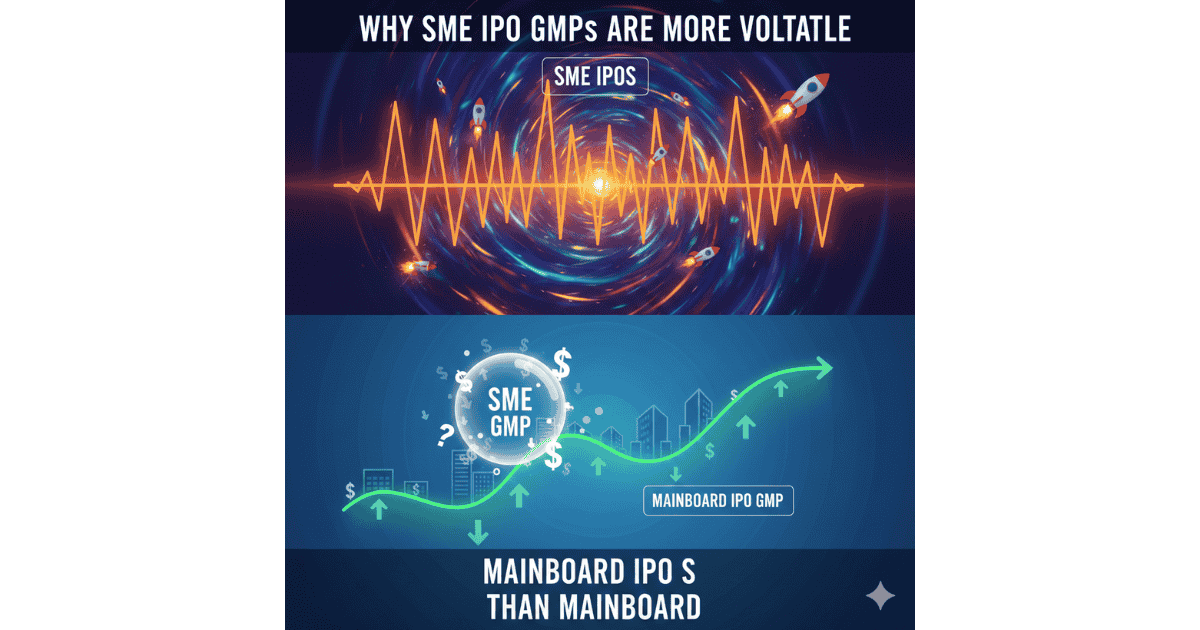
Why SME IPO GMPs Are More Volatile Than Mainboard
Overview
Grey Market Premiums (GMPs) are widely tracked indicators in India’s IPO ecosystem. While both SME and mainboard IPOs attract GMP activity, volatility tends to be materially higher in the SME segment. This outlook explains the structural, behavioural, and market-design factors that drive this divergence, using an institutional and non-advisory lens.
Market Structure Differences Between SME and Mainboard IPOs
SME IPOs operate within a narrower market framework compared to mainboard offerings. Issue sizes are smaller, lot sizes are higher, and the investor universe is relatively limited. These structural constraints result in thinner grey market activity, where even a small change in sentiment or participation can cause disproportionate GMP movement.
In contrast, mainboard IPOs typically benefit from broader participation, including institutions, anchor investors, and higher retail depth, which helps dampen short-term volatility.
Liquidity and Participation Dynamics
SME IPO grey markets often involve a limited set of dealers and participants. With fewer trades setting reference prices, GMPs can swing sharply on isolated transactions. Liquidity constraints mean that quoted premiums may not reflect consensus demand but rather marginal activity.
Mainboard GMPs, while still unofficial, usually derive from a larger pool of transactions, offering relatively smoother price discovery.
Why SME IPO GMPs Are More Volatile Than Mainboard: Information Asymmetry and Disclosure Depth
SME IPO disclosures, while compliant with regulatory requirements, are often less extensive than those of mainboard issuers. This can increase uncertainty, leading market participants to react more strongly to partial information, rumours, or early subscription trends.
Mainboard IPOs typically have longer operating histories, wider analyst coverage, and more detailed disclosures, reducing abrupt sentiment shifts.
SEBI ICDR regulations for IPOs
Retail-Dominated Sentiment Cycles
Retail investors play a dominant role in SME IPOs. Retail-driven sentiment tends to be more reactive to short-term cues such as subscription headlines or social media commentary. This behavioural factor amplifies GMP volatility, especially during the early days of the issue.
Institutional participation in mainboard IPOs provides a stabilising counterbalance, anchoring expectations closer to fundamentals.
SEBI investor education on IPOs
Subscription Patterns and Timing Effects
SME IPO subscription data often shows sharp day-to-day swings due to lower base volumes. GMPs can respond immediately to these changes, even when the absolute numbers remain modest. Mainboard IPO subscriptions, due to scale, tend to show more gradual shifts.
Post-listing trading conditions also influence pre-listing GMP behaviour. SME stocks are subject to trade-to-trade settlement and lower liquidity, which can heighten perceived risk. This risk perception feeds back into grey market pricing, increasing volatility.
- SME IPO GMPs reflect sentiment, not valuation.
- Volatility is structurally higher due to market design.
- Single data points can distort perception.
- Comparisons with mainboard GMPs require context.
From an institutional standpoint, SME IPO GMP volatility is not an anomaly but a predictable outcome of market structure, participant mix, and liquidity constraints. As such, GMPs should be viewed as a qualitative sentiment gauge rather than a directional signal.
Overreliance on GMPs without considering disclosures, governance, and business sustainability can lead to misinterpretation, particularly in the SME space.
Readers tracking SME IPOs can use this framework to contextualise GMP movements, separating structural volatility from meaningful demand signals. Linking GMP behaviour with subscription quality and disclosure depth provides a more balanced view.
This content is for educational and informational purposes only. It does not constitute investment advice, a recommendation, or an offer to buy or sell any securities. IPO grey market data is unofficial and may not reflect actual market outcomes.
About The Author