



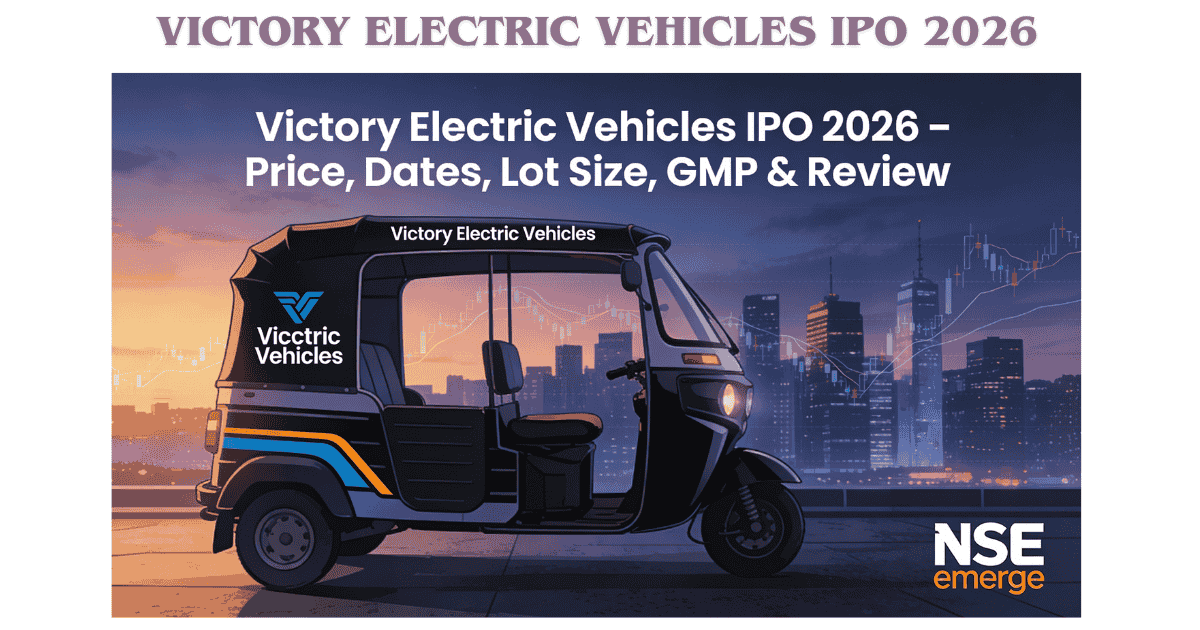

Victory Electric Vehicles IPO 2026:
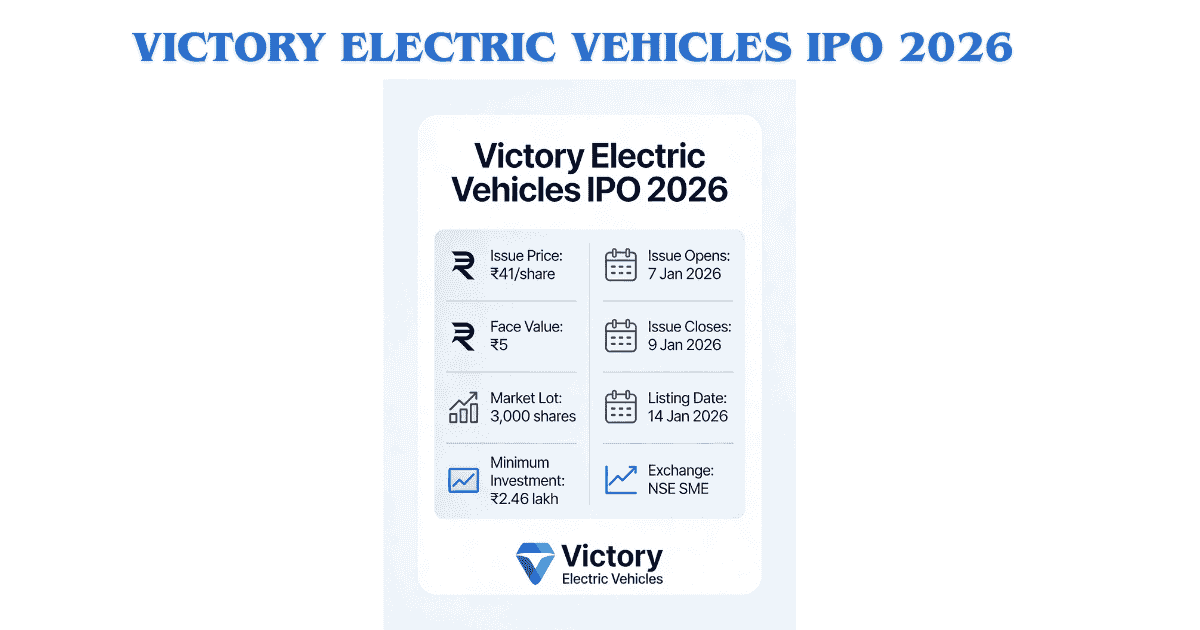
Victory Electric Vehicles International Limited (VEV) is coming out with an SME IPO on NSE Emerge with a fixed issue price of ₹41 per share, targeting India’s fast‑growing electric three‑wheeler and last‑mile mobility market. The issue opens on 7 January 2026 and closes on 9 January 2026, with a relatively high minimum retail investment because of the large SME lot size.
Victory Electric Vehicles IPO 2026: Key Highlights
- Company:
Victory Electric Vehicles International Limited (EV 3‑wheeler and e‑mobility manufacturer). - Exchange:
The NSE SME/ NSE Emerge platform. - Issue type:
Fixed price SME IPO; 100% fresh equity shares. - Issue size:
Around ₹34.56–₹35 crore, aggregating ~84.3 lakh equity shares of face value ₹5 each at ₹41 per share. - Use of proceeds:
The proceeds will be used for capital expenditure on plant and machinery, working capital, and general corporate purposes to expand EV manufacturing and dealer reach.
Victory Electric Vehicles IPO 2026: IPO Dates, Price, Lot Size
- Bidding/Issue open:
7 January 2026. - Issue close:
9 January 2026. - Basis of allotment:
12 January 2026 (tentative). - Credit to Demat:
13 January 2026. - Listing date:
January 14, 2026, on NSE SME.
Victory Electric Vehicles IPO 2026: Key pricing and lot metrics:
- Issue price:
₹41 per share (fixed price). - Face value:
₹5 per share. - Market lot:
The SME structure requires retail investors to purchase a minimum of 2 lots, which equals 6,000 shares. - Minimum retail investment:
The minimum retail investment is approximately ₹2,46,000 for purchasing 6,000 shares at a price of ₹41 each.
Victory Electric Vehicles IPO 2026: Business Overview & Growth Drivers
Victory Electric Vehicles focuses on electric three‑wheelers (L3 and L5), e‑cargo loaders, e‑rickshaws, and electric scooters for last‑mile and intra‑city transport. The company operates from Bahadurgarh, Haryana, with a growing dealer network spread across nearly 12–15 Indian states, tapping tier‑2 and tier‑3 EV demand.
Key business strengths:
- ICAT‑approved L5 electric three‑wheelers and L3 e‑rickshaws for both passenger and cargo segments, helping the company address B2C and B2B use‑cases.
- The company possesses in-house manufacturing and customization capabilities, including specialized models such as food vans and ice cream vehicles, which contribute to improved margins and customer loyalty.
- Focus on lithium‑ion battery technology, electric drivetrains, and localized components to align with government incentives for clean, affordable mobility.
From a sector perspective, India’s EV market, especially e‑rickshaws and electric three‑wheelers, is expected to grow at a very high CAGR through the second half of this decade, driven by fuel savings, urban pollution control, and state‑level EV policies. This structural tailwind supports volume growth, dealership expansion, and potential operating leverage for focused players like Victory Electric Vehicles.
Victory Electric Vehicles IPO 2026: Issue Objects, Financial Snapshot & Valuation
Use of IPO proceeds:
- Capital expenditure:
Around ₹5 crore for capacity expansion, CNC cutting, painting lines, and related plant upgrades to enhance EV output. - Working capital:
Around ₹18 crore is earmarked for inventory, receivables, and channel financing as the dealer footprint scales up. - General corporate purposes:
~₹6.78 crore for branding, infrastructure, and other strategic requirements.
Recent performance and ratios (FY2025‑linked data where available):
- FY2025 revenue:
Around ₹50–51 crore, reflecting healthy top‑line momentum in EV sales. - FY2025 PAT:
Around ₹5.17 crore, implying a double‑digit PAT margin and positive operating leverage. - Profitability metrics:
ROE of ~42%, ROCE around 31%, and EBITDA margin of ~15%, indicating efficient capital use for a small‑cap EV manufacturer. - Leverage:
Debt-equity ratio near 0.5–0.62, suggesting moderate but manageable gearing typical of a manufacturing-led SME.
Valuation commentary:
- The IPO is valued at a price‑to‑book multiple of about 4.3x and is positioned as a growth play on India’s EV adoption curve.
- On earnings and peer comparisons within the SME EV and auto‑ancillary space, the valuation reflects premium pricing for growth but still aligns with market enthusiasm for clean mobility themes.
Victory Electric Vehicles IPO 2026: Risk Factors & Investor Considerations
Investors should be aware of key risks even as the IPO rides on a strong EV narrative. Like many SMEs, Victory Electric Vehicles depends significantly on raw material costs, supply chains, and key dealers, which can impact margins and growth if disruptions occur.
Important risk elements:
- Risks include concentration in vendors and clients, as well as sensitivity to globally volatile battery and metal prices.
- There is intense competition from unlisted regional players and larger listed EV/auto OEMs, who may exert pricing pressure and require sustained R&D/marketing spending.
- Regulatory and policy risks exist because EV subsidies, GST rates, and state-level incentives significantly influence the payback periods for both buyers and fleet operators.
The high minimum ticket size of about ₹2.46 lakh and the fact that SMEs are more liquid make this offer better for knowledgeable HNIs and aggressive retail investors than for people who have never participated in an IPO before. Listing performance will depend on subscription quality, grey‑market sentiment, and broader EV sector flows, with early GMP indications currently muted around the issue price level.
READ MORE: Yajur Fibres IPO 2026: Complete Analysis, GMP, Price, Subscription & Investment Review
Victory Electric Vehicles IPO 2026: Final View on Victory Electric Vehicles IPO
Victory Electric Vehicles IPO provides exposure to a pure‑play electric three‑wheeler and last‑mile mobility manufacturer at an early stage of India’s EV transition. Strong revenue growth, healthy margins, and ambitious capacity expansion plans are positives, but investors must weigh these against SME‑specific risks, sector competition, and the relatively rich valuation and high minimum investment size.
About The Author